
Faites vos jeux

Regulators in several countries immediately moved to block ADI Predictstreet, Fifa’s $150m prediction market sponsor, for operating illegally on the very day it went live.

By Martin Calladine, Philippe Auclair and Sam Kunti

This is the sixth part of Josimar’s investigation into Fifa’s partnership with Predictstreet. The first part reported that the company’s founder paid a six-figure sum to settle accusations of insider trading. The second part revealed Predictstreet’s new CEO’s ties to Qatargate, one of the biggest lobbying scandals in EU history. The third part detailed how, in 2018, Predictstreet’s head of anti-money laundering (AML) accepted a two-year ban on financial activity in Gibraltar after overseeing AML failings at a former employer. The fourth part revealed how ADI Predictstreet received its Gibraltar gambling licence a mere nine days after the company was founded, and that one of its directors works for a law firm of which the Minister who issued that licence is a partner. The fifth part reported that ADI had failed to trademark any of its IP and was being cybersquatted in the Google app store by an illegal casino.

Fifa’s early April announcement of ADI Predictstreet as its first prediction market partner raised immediate eyebrows: a two-week-old company paying a reported $150m to sponsor the World Cup without even having a working product. While backers promised clarity by the launch on 9 April, the deadline passed with no functioning website – and only a string of red flags about the Abu Dhabi royal family-backed project. 

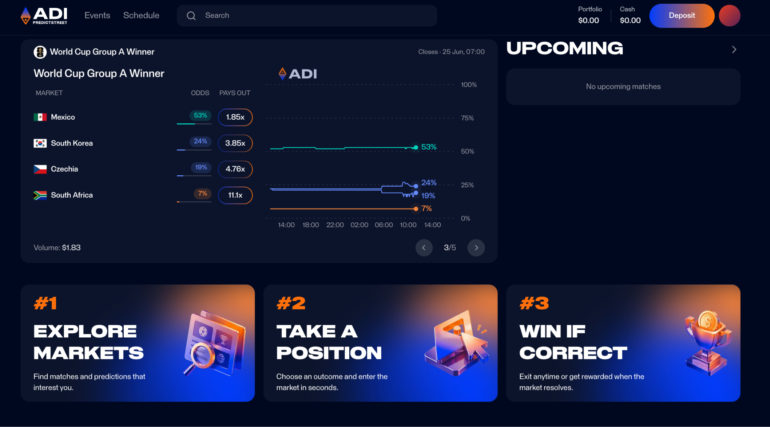
Last week, on 3 June, ADI Predictstreet’s website went live at last. Unlike Polymarket and Kalshi, the company’s better-known competitors, the site didn’t list hundreds of markets across a range of sectors. In fact, it had just 16 markets on offer at launch, all of them World Cup-related.

Prisoners of geography

Part of the problem is that ADI Predictstreet is licensed only in Gibraltar, a territory of just 40,000 people. Article 3 of the Macolin Convention, to which Norway is a signatory, defines illegal betting as “any sports betting activity whose type or operator is not allowed under the applicable law of the jurisdiction where the consumer is located.” 

On the day the site launched, a Josimar reporter in the UK opened an account with ADI Predictstreet by providing a UK phone number and physical address during the onboarding process. Similar attempts in France and Belgium were also successful. No warning appeared at any stage of the registration. Josimar then contacted several national gambling regulators for their assessment of the ADI Predictstreet website. 

We understand that the French gambling regulator Agence Nationale des Jeux (ANJ) issued two cease-and-desist notices to Predictstreet last week before adding Fifa’s official partner to its black list and blocking it on the French territory, right before the start of World Cup. Josimar can confirm that two other European regulators, both speaking on condition of anonymity, moved to block ADI Predictstreet almost instantly. Meanwhile a UK Gambling Commission spokesperson said, “We do not talk about individual cases but whenever we become aware of an unlicensed operator we take action.”

Late in the afternoon or early evening of 3 June, ADI Predictstreet introduced geoblocking in 56 countries and scrubbed the FAQs from its website. The UK was on this blocklist, yet, two days later, a Josimar reporter bypassed it using a simple VPN and completed a vetting process to allow the depositing of up to 2,000 USDC and the withdrawal of any winnings. This required the provision of a UK passport, a facial scan and a recent utility bill, which matched the UK address used at registration. 

As of 5 June, it was still possible to access and register on ADI Predictstreet in a number of jurisdictions where it cannot operate legally, including Japan, Turkey, Hong Kong, India and Singapore. In Brazil, users could also register and go through the vetting process to deposit, even if prediction markets are outlawed in the country. Josimar understands that Brazilian authorities are looking into it. 

Initially, the site was blocked in the United Arab Emirates, the nation of which Abu Dhabi is a constituent emirate. On 8 June, after Josimar approached ADI Predictstreet to ask why it was blocked in its home territory, the UAE was removed from the blocklist. Ironically, it is impossible to trade on ADI Predictstreet’s own platform (though possible on their co-brand Fanatics) in two of the three countries which co-host the 2026 World Cup, USA and Canada, while it is unlicensed in Mexico.

Duty of compliance

In the original FAQs, dated “April 2026” and published when the site was launched at the beginning of June, ADI Predictstreet stated that it operated “under its Gibraltar licence and [accepted] customers from countries where it is not illegal to use our services.” However, at the time of the launch, the site could be accessed and used from anywhere, including countries where ADI Predicstreet isn’t licensed – that is, anywhere outside of Gibraltar – and places where all online gambling is illegal, like much of South and South-East Asia.* To address regulatory concerns, it is standard industry practice for gambling companies to geoblock their website in countries where they aren’t licensed.

The website FAQs also said, “We do not accept customers from certain restricted countries — you will be informed during registration if your country is not currently supported” and included the following disclaimer, in line with Gibraltar regulations, which suggested that the duty of compliance was transferred at least in part to Predictstreet customers: “NOTE: It is your responsibility to ensure that using ADI Predictstreet is legal in your country of residence. If you are unsure, please seek local legal advice before registering”.

Screenshot from ADI Predictstreet’s FAQs sheet, which was subsequently removed from their website.

Slow rollout

The rest of ADI Predictstreet’s deployment has been haphazard. Despite the company’s social media ads showcasing screenshots of a mobile app, no such app is actually available. An “ADI Predictstreet” app did briefly surface on the Google Play store. Impersonators had hijacked the brand to promote an illegal casino. A couple of weeks later, the app was hijacked a second time, this time to propose a range of kitchenware to British customers. Days later, and with the ADI Predictstreet website just set live, a second fake app appeared, this time a puzzle game.

Commercial concerns

The delayed launch has created a financial problem for the platform. ADI Predictstreet is a prediction market where customers bet against each other rather than against the house, as they would with a traditional sportsbook, which requires a critical mass of users before any meaningful volume of bets can be placed. On the eve of the World Cup – when a sponsor would expect to be profiting from its association with the tournament – there is close to zero liquidity in ADI Predictstreet. What few customers have signed up will struggle to spend their money on the platform yet, as there is barely anyone to bet against. Consequently, the company which has already disgorged a reported 150 million USD to become an official Fifa partner may be forced to spend tens of millions of dollars more to leverage bets on its own platform to help kickstart the project. 

By way of comparison, Polymarket, the largest prediction market company alongside Kalshi, has already taken well over 1.5 billion USD of wagers on its “World Cup Winner” market alone. As the commissions taken by prediction markets are very low, much lower than the margins worked into the odds of traditional sportsbooks, especially in the early stages of their development when attracting traders is key, Predictstreet will have to process billions of dollars in trades to make back their initial investment. It will be a tough ask to meet such a target, when the current volume of trades is so low that New Zealand was shown as a “favourite” to win the tournament at the time of writing.

Then, on 27 May, ADI Predictstreet announced a co-brand with Fanatics Markets, the prediction market launched by the Fanatics sportswear and collectibles company in December 2025, now licensed in 24 US states. For an undisclosed fee, ADI is allowing a direct competitor to use its brand and official World Cup partner status. On the face of it, this is an odd deal for a company to sign only days before launching its own website.

Fanatics Markets home page, featuring ADI Predictstreet’s and Fifa logos.

Cryptic crypto

The website’s financial system also raises questions about the funding and purpose of the project. Like Polymarket, ADI uses USDC, a crypto stablecoin, for transactions. However, in the FAQs document on the website, it said:

ADI Predictstreet operates in USD1 — USD Coin — a stablecoin pegged 1:1 to the US dollar… USD1 is issued by World Liberty Financial and is a widely used and regulated stablecoin.”

World Liberty Financial (WLF) is a company originally founded and majority-owned by the family of US President Donald Trump. According to theWall Street Journal, “The Trumps receive 75% of net proceeds when World Liberty sells tokens, plus a cut of stablecoin returns. That revenue share would translate into about $1 billion in proceeds so far for the Trumps. The Trumps’ unsold tokens were worth about $3 billion as of December [2025].”

A screenshot of ADI Predictstreet’s FAQs.

In January 2025, four days before Trump’s second inauguration, Sheikh Tahnoon bin Zayed Al Nahyan, a senior member of the Abu Dhabi royal family, oversaw the undisclosed purchase of 49% of WLF, in a deal that was worth $187m to Trump’s family. Another beneficiary was Steve Witkoff, the United States special envoy to the Middle East whose stake in WLF brought him $31m. Tahnoon, who is sometimes called the “Spy Sheikh”, followed this up in May 2025 with a $2bn investment in the crypto exchange Binance, which was made via WLF – again earning profits for its shareholders. The money came from MGX, which is another Abu Dhabi government-controlled investment vehicle, although not part of the conglomerate that is the ultimate owner of ADI, the International Holding Company (IHC), of which Tahnoon is also the chair.

The New York Times subsequently raised concerns about the proximity of these transactions to an agreement, brokered by Witkoff two weeks after the Binance deal, to allow the UAE access to advanced AI chips. This came, “despite national security concerns that the chips could be shared with China.” Just last week, Congress questioned US Secretary of State Marco Rubio about WLF, Witkoff and the Trump family’s financial connections in the Middle East.

And so it appears that ADI Predictstreet was initially intended as a project which would use a stablecoin in which the company’s owners had a shared financial interest with the US President. Why this idea was abandoned and USD1 switched out for a competitor stablecoin is unknown. The FAQs document disclosing the USD1 plan was subsequently replaced with one that omitted this information.

Meanwhile, with the World Cup just around the corner, ADI Predictstreet is a business with no standalone app and virtually no customers, instead relying on a co-branded partnership with a far better-known competitor and saddled with a significant sponsorship spend that it must somehow recoup.

ADI Predictstreet didn’t respond to several requests for comment, but did forward to Josimar a press release announcing the launch of the website. Fifa has been contacted for comment.

Zeen is a next generation WordPress theme. It’s powerful, beautifully designed and comes with everything you need to engage your visitors and increase conversions.