
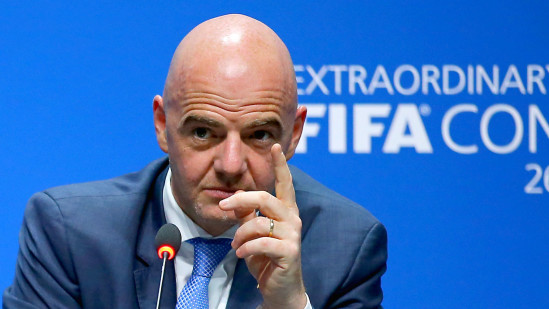
The press remains one of the last checks on Fifa’s power. Gianni Infantino and his media office are cracking down on it.
A Josimar editorial.
At the recent Fifa Congress in Vancouver, Canada, Josimar experienced déjà vu. It had to chase Gianni Infantino through the corridors of the local convention centre in order to ask him: “Are you not embarrassed by the high prices for the World Cup? Which makes this World Cup a World Cup for the rich. For the rich fans. Would you care to comment?” Shielded by a phalanx of media officers, bodyguards and staff, the Fifa president responded: “I will comment whenever I decide to comment on everything. Thank you so much.”
Infantino doesn’t want to entertain questions from the press. What Infantino does want – even if Fifa’s statutory rules limit presidents to twelve years in office and he was first elected in 2016 – are four more years at the helm of the world federation and, some whisper, wouldn’t mind another four years after that. So, he promised to shower the 211 member associations with $14 billion in revenue – and declared his candidacy for the 2027 Fifa presidential election, which had already been unanimously endorsed by the African and Asian confederations. Loyalty always has a price tag. Perceived lack of it also does, as the executives of the Trinidad & Tobago FA found to their cost. Where there’s a carrot, the stick never is that far.
Today, the press is one of the last guardrails against the unfettered power of Gianni Infantino, who, from the moment he took office, has mismanaged Fifa and the global game. The man who had been elected on a promise of change (for the better, we were led to believe), promising transparency and accountability, started by firing head of governance Miguel Maduro, orchestrated the eviction of CAF president Ahmad Ahmad and its replacement by Patrice Motsepe, secretly supported the European Super League, fast-tracked the award of the 2034 World Cup to Saudi Arabia, recently brought a shady operator, Adi PredictStreet on board as a new prediction market partner, gave his blessing to the pricing out of fans out of the 2026 World Cup and crowned it all by giving President Donald Trump the inaugural “Fifa Peace Prize” without prior consultation in a stomach-churning show of sycophancy. He has hollowed out good governance.
On the eve of the last World Cup, Josimar warned in an editorial that with ‘Gianni Infantino at the wheel, we are nowhere near the bottom’. Those words have proven to be prescient.
Infantino’s disdain
Infantino arrived at Fifa masquerading as a reformer. Instead, he has gone to great lengths to concentrate and consolidate his power. And yet, despite all the skulduggery, hardly any of the people to whom he ultimately owes his position are holding the Fifa president and his cabal to account.
Instead, the 211 member associations feast on development money through the Forward programme on which their very existence often depends. Fifa Council members, most of whom are totally unknown from the general public, attend a handful of meetings – from two to four – each year in order to pocket an annual stipend of $250,000-$300,000. The role of that docile herd of officials is merely to rubber stamp the decisions which will have been taken before they checked in at their five-star hotels. The confederation presidents, once a troublesome lot, now accept and sustain the system.
The inapt Swiss legal system does nothing to address Fifa’s unique modus operandi, legally a “not for profit” association with the turnover of a multinational company.
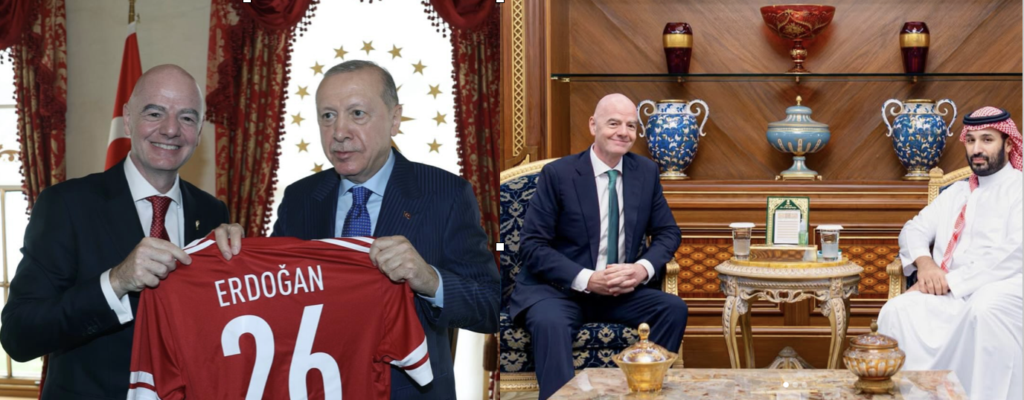
Politicians around the world – preferably “strongmen”, autocrats and dictators a la Paul Kagame – appear in photo ops with Infantino, keen to tap the global appeal of the game for their personal benefit. The European Union which, should it wish to, would have the power to rein in the Infantino regime, has never mustered the political will to do so – even less so in the current geopolitically fractured world. The world’s footballers trade union FIFPro – under threat from Fifa setting up “yellow” players associations – have been close to follow criticism with action, but have refrained from it so far.
So the task of holding the global governing body to account falls to journalists, alongside NGOs and fans. The courageous reporting of the New York Times’ Tariq Panja, The Times’ Martyn Ziegler, Le Monde’s Rémi Dupré and Idrettspolitikk’s Andreas Selliaas among others has often shed light on the dark inner workings of Fifa.
Infantino’s disdain for the press, in sharp contrast with his accessibility when he was Michel Platini’s number 2 at Uefa, is an open secret. On the eve of the 2022 World Cup in Qatar, he launched into an hour-long tirade in defence of the host nation and accused the press of racism. A year later, at the 2023 Fifa Congress in Kigali, Rwanda, Infantino doubled down with a spiteful speech, demanding that the press would report more about the actual game than football administration. He asked: “Why are some of you so mean?”
British journalist Matt Slater from The Athletic offered an eloquent reply: “The criticism for your speech in Doha was not about your gag on red hair. It was about the implicit and explicit criticism you made of dozens of people in that room of the reporting they had done over a decade on Qatar’s labour rights rules. You said ‘we were racists’. Now, ironically, that’s the word the UN special rapporteur used or uses about the labour rights situation in Qatar.”
When Josimar’s Pål Ødegaard demanded Infantino simply respond to questions instead of delivering monologues, the Fifa president was fuming. It would be the last time the world’s press would get the opportunity to properly ask him questions. Except for an impromptu press gathering in Auckland, he’d not stage a press conference again.
At the 2024 Fifa Congress in Bangkok, Thailand, he simply got the customary post-congress press conference cancelled. Journalists cornered him in hotel lobbies to ask about Saudi Arabia, but Infantino refused to be drawn into this topic. A Fifa media officer quipped: “How often do you speak to a head of state?” She could have been told that Infantino’s predecessor Sepp Blatter, whatever his faults, never skipped a presser or shunned journalists, including those who were the most hostile to him.
Fifa stepped up its attack on the press. In oppressive Asuncion, Paraguay, where 5,000 police officers, tanks and soldiers lined the streets for the 2025 Fifa Congress, the world federation shut journalists out of its main hotel. At the recent Fifa Congress in Vancouver, Canada, Fifa denied reporters access to the floor of the Congress, a long-held tradition. The rationale? To shield Infantino from questions at all cost.
Culture of silence
Such is Fifa’s paranoia that reporters often get escorted by media officers during a congress to ensure they can’t talk to delegates outside of the tightly controlled mixed zone. When a journalist does encounter a delegate in person, a Fifa minder will often demand that questions are first emailed to the media office. That e-mail will mostly go unanswered. Josimar organised an informal poll of journalists working on the Fifa “beat”. Every single respondent said that the situation has deteriorated under Infantino. Most of them – like Josimar – no longer receive replies to questions addressed to the Fifa press office or the organisation’s various committees, even when these questions deal with clarification of facts or regulations. Infantino’s rare “interviews” are either micro-managed Q&As in which the questions have all been vetted in advance, such as his appearance on Sky News last February, or stunts like the Fifa president’s excruciating appearance on US influencer IShowSpeed’s YouTube channel at the 2025 Club World Cup.
Under Fifa’s director of media relations Bryan Swanson, who left Sky Sports News to become Infantino’s chief media enforcer in 2021, the media office has morphed into a PR wing, focused on churning out fawning propaganda, crisis management and blocking journalists every step of the way. It invites a simple question: what is it that they want to hide?
At the Congress, a Canadian journalist said: “The only place where I didn’t get escorted was the toilet.” An American journalist described his recent experience of Fifa Media and Infantino’s bodyguards shadowing him: “If I took a step to the right, they took a step to the right; one step to the left, they took a step to the left”.
This has a chilling effect. Newsrooms, already under immense economic pressure, are sending fewer reporters due to the lack of access, resulting in even less scrutiny. Public fatigue and quasi-universal disillusionment with Fifa (“they’re all corrupt anyway!”) also discourage editors to focus on or follow up on stories which, in Blatter’s time, would have been given the front page, such as Infantino’s tax arrangements in Switzerland, his mysterious 2015 trip to the USA and his role in the sale of Uefa media rights to corrupt South American agents who were later convicted in the Fifagate trials.
The culture of silence has spread. Chief officers at Fifa refuse to explain major decisions of the organisation. Fifa Council members and FA presidents – the likes of Cameroon’s Samuel Eto’o and Estonia’s Aivar Pohlak – rarely speak on the record. A code of silence protects the system.
Once viewed as mildly progressive, German FA (DFB) president Bernd Neuendorf has fallen into line after the 2022 World Cup. As a Fifa Council member, he receives $250,000 plus, as DFB president, 250,000 euro per annum, but Neuendorf dodged the German press in Vancouver. He has been a staunch defender of the Fifa Peace Prize, telling German broadcaster WDR that he believed that “the conflict [in Gaza] could not have been ended without the USA”. British businesswoman Debbie Hewitt has not granted an interview to a non-institutional media or held a public press conference since being elected Fifa Vice-President by the Uefa Congress in April 2023 (*). She earns $300,000 from that role and $149,000 as chairwoman of the English FA.
While sports have never enjoyed such immense wealth and influence, the wall between the public and the truth has never been higher. Critical journalism is more essential than ever. This lack of transparency isn’t just a problem for football; it is a red flag for democracy. Infantino has adopted the dictator’s playbook but the message from the rooftops is clear: he is not fit to govern football.
(*) Hewitt last spoke publicly in June 2025, doing an on-stage “interview” at a Uefa conference which was closed to journalists.