
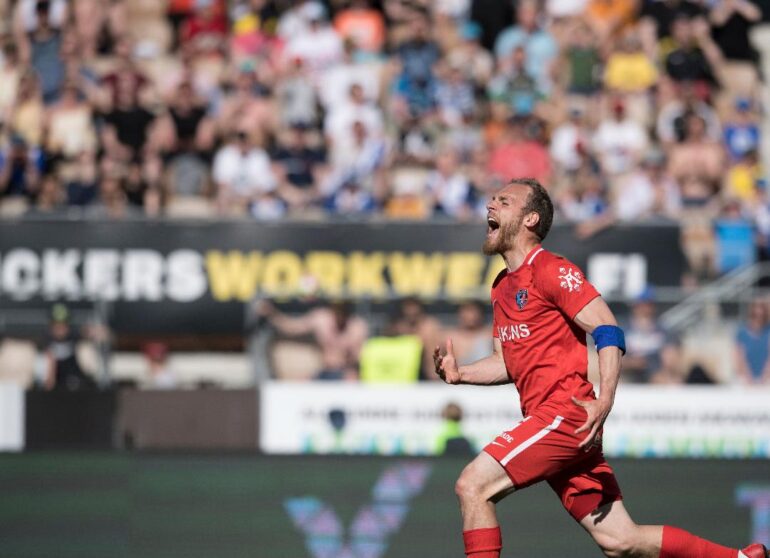
In an interview with Timo Furuholm, Finnish parliamentarian and former footballer, Josimar explores why so many players lean right-wing and discusses the upcoming World Cup.
By Jules Boykoff, author of Red Card
When I asked the former Finland international Timo Furuholm whether the United States should be permitted to host the 2026 World Cup amid its ongoing attacks on Iran, he replied without hesitation, “If I’m honest, no. They shouldn’t be allowed to organise the World Cup in this situation.” But this wasn’t just any ex-footballer popping off with an off-the-cuff hot take. This was a member of parliament. After retiring from football in 2021, following a nearly twenty-year professional career, Furuholm made the leap to politics, running successfully for a seat on the Turku City Council. Then, in 2023, he ascended to Finland’s national parliament, elected as a member of the Left Alliance, a party known for its commitment to the environment, economic democracy, and racial and gender equality.
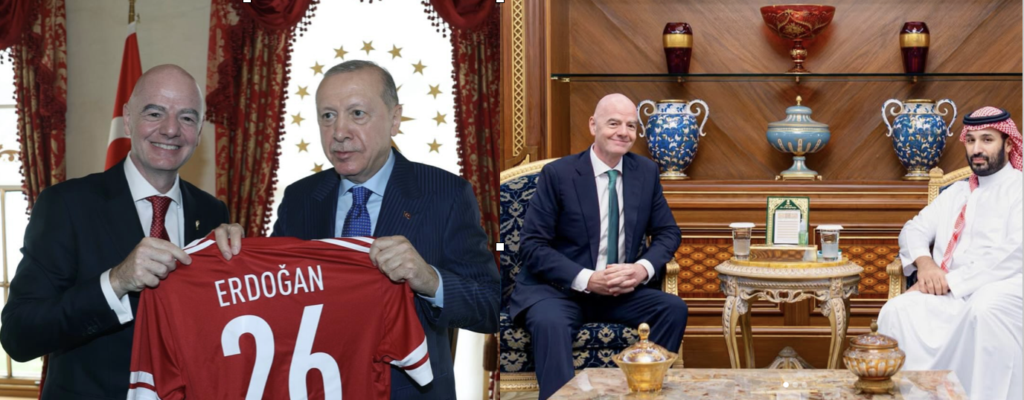
Perhaps Furuholm’s stance should come as no surprise. After all, when Fifa President Gianni Infantino hand-delivered the inaugural Fifa Peace Prize to US President Donald Trump last December, Furuholm tweeted, “What the hell is going on? This kind of ass-licking is embarrassing – even for Fifa.” Sitting in Little Parliament, the annex adjacent to the Finnish Parliament building in Helsinki, he elaborated. “It’s an embarrassment for the whole football community that the head of the organization is acting like that.” He added, “I think that Infantino, and Fifa itself, is a bit afraid at what will happen during the World Cup.” After all, hosting the tournament allows Trump “to do whatever he likes…and he has already done and said a lot of stupid things.”
In advocating for the United States to be stripped of hosting duties, Furuholm pointed to the travel bans that the Trump administration has leveled against participating countries such as Iran, Haiti, Senegal, and Ivory Coast. “This is when Fifa should position itself to defend football fans, but [instead they do] nothing,” he told Josimar. Meanwhile, Trump is actively damaging “international law and the rule-based world order” in ways that resemble the actions of Vladimir Putin: “Not on the same scale—Putin wants to take the whole of Ukraine—but the mechanism is the same.” Furuholm stated that it’s a major problem that “Nowadays you can play a World Cup in a country which is illegally attacking other countries.”
Furuholm explained, “I want to be a romantic” when it comes to football. But Fifa makes that difficult. “Fifa nowadays is more about greediness, it’s more about neoliberalism, capitalism. Of course, I understand that football is big business, but they have lost the idea of the World Cup,” he noted. “Football today is a tool of sportswashing,” he said, pointing to how Fifa had handed its crown-jewel tournament to Putin, to Qatar, and now to Trump. “Fifa is ready to sell football to the one who is willing to pay the most…It’s not a sport for everyone anymore. It’s a sport for the rich and it’s the sport for authoritarian leaders.”
Conservative players
When it comes to footballers who pivot to politics, the fact that Timo Furuholm is a leftist is somewhat of an anomaly. Unlike many of his fellow footballers-turned-politicians—such as Georgia’s firebrand President Mikheil Kavelashvili, Paraguay’s presidential aspirant José Luis Chilavert, or pro-Putin politicos Andrey Arshavin and Roman Pavlyuchenko—Furuholm is a real-deal leftist. His party, the Left Alliance, describes itself as “red-green civic movement. We work for a just, equal and free society. We are building an ecologically sustainable welfare state where everyone has equal opportunities to take care of themselves and their loved ones.”
And yet, most footballers who hop into formal roles in the political arena tend to swerve in a conservative direction. Take Carlos Mac Allister, the former Argentinian international who inhabited the midfield at Boca Juniors alongside outspoken leftist Diego Maradona and who is the father of Alexis Mac Allister of Liverpool and Argentina’s 2022 World Cup winners. In 2013, he was elected to Argentina’s national parliament representing the right-of-center Frente Propuesta Federal.
Even George Weah, the Ballon d’Or winner-turned-president of Liberia, governed as a centrist or center-right politician, after running a campaign that promised to curb corruption and address poverty. Moreover, scholar Robtel Neajai Pailey asserts that “greed and graft” were “hallmarks of his presidency.” Weah’s greatest political accomplishment may have been agreeing to a peaceful transfer of power when he was defeated in an election for president in 2023, a significant move for which he was feted.
To be sure, some footballers who enter institutional politics veer to the left. There’s Giovanni “Gianni” Rivera, the Italy international and AC Milan legend who served in Italy’s Chamber of Deputies as well as the European Parliament. And, of course, there’s Romário, who as a member of the Brazilian Socialist Party elected toBrazil’s National Congress, lambasted Fifa and the Brazilian politicos in its service ahead of the 2014 World Cup. He dubbed Fifa “the real president of Brazil” and said, “It’s taking the piss with our money, with the public’s money, it’s a lack of respect, a lack of scruples.” But over time, Romário inched his way rightward along the political spectrum. By 2021, he supported the far-right Jair Bolsonaro for president over Luiz Inácio Lula da Silva. (Romário wasn’t alone among Brazilian football icons: Ronaldinho also backed Bolsonaro, as did Neymar).
The general rule is that famous footballers-turned-politicians trend to the right with their politics. To a certain degree, this can be attributed to class dynamics. Successful professional football players tend to accumulate wealth, which creates a built-in incentive to jettison left-of-center groups that may wish to redistribute that wealth.
“A paradox of football is that while it is a supremely collective game and experience, the life of players is highly individualistic,” football historian David Goldblatt told Josimar. Footballers are “endlessly in competition for their place, precariously navigating a career in which, in the end, only they are looking out for their interests” and this inflects their outlook. Goldblatt added, “Certainly in Britain since the end of the maximum wage, a lot of footballers have made the journey from working-class roots to middle-class suburbs with the usual political shift. In Brazil, protestant evangelism has helped accelerate that process.”
The football historian Brenda Elsey said the transition from footballer to right-winger “makes perfect sense,” adding, “in a sport so patriarchal and homophobic, it is surprising when players don’t support right-wingers.” She told Josimar, “Though often disappointing to their working-class fans, elite footballers usually align with fellow millionaires. Many are convinced that through their individual talent and hard work, they deserve to enjoy privilege.” Elsey, who specialises in Latin American football politics, noted that in that region footballers “are often from impoverished barrios that have not benefitted equally from social programs.” And many come from deeply religious evangelical families that have long been courted by right-wing political movements.
Furuholm himself had theories on the right-wing predilections of footballers who, like him, became politicians. “Sport involves a certain ethos of success that is rooted in uncertainty,” he said. In Finland, this enables “right-wing politicians [to] promote the idea that everyone is the architect of their own fortune” and to deploy athletes “as representatives of this way of thinking.” He also noted how Finland’s Prime Minister, Petteri Orpo of the National Coalition Party, has “captured” elite sport in the country. Therefore, “One could say that sport has shifted to the right since the time when the working class had a strong position in the Finnish sporting landscape,” he explained.
Finnish sociologist Antti Jauhiainen pointed to another potential explanation for rightwing dominance of the athlete-turned-politician front in Finland: recruitment strategies. “It might be that left in general has been more active to recruit from academic, cultural, and labor-union circles,” he told Josimar. “It might take [more] time [for the left] to build bridges towards the traditionally right-leaning sports community.” Jauhiainen noted that in Finland, numerous former high-level athletes who either work in politics or actively engage with it, “all are basically leaning conservative or right-wing,” with Lasse Viren (Olympic champion in long-distance running), Juha Mieto (Olympic medal-winner in cross-country skiing), and Sinuhe Wallinheimo (ice hockey) more center-right and Teemu Selänne (ice hockey) sharply right-wing, outspoken in his support for US President Donald Trump.
Breakfast of Champions
Furuholm said that he has long been committed to “left-wing values” and that his leftism is rooted in his homelife. Growing up in Pori in western Finland, his father was a local politician who served on the city council. All his siblings are leftists. Living through the economic recession of the 1990s allowed him to see firsthand how many working-class people were struggling. This instilled in him the bedrock principle that “You can make a lot of choices in your life, but the starting point is not the same for everyone.” That same insight animates him today in the Parliament of Finland.
When Furuholm started in politics in 2021, he described being driven by values like solidarity and equality, which were sentiments he has already expressed as a footballer when he stood against racism and homophobia, and openly supported left-wing politicians such as Paavo Arhinmäki and Li Andersson. But being a member of Parliament allows him to go much deeper, he said, and to link these issues to the political dynamics undergirding labor markets, social security, and neoliberalism, and to challenge what he called “hyper-capitalism.” Furuholm suggested, “It may well be that the harsh world of elite sport has only strengthened my belief that society should not be like elite sport, but that we need safety nets and a strong state to create opportunities.” He added, “I don’t want to think that living an ordinary life should require the same kinds of sacrifices and competition as elite sport.”
As a footballer, Furuholm was an avid reader. “Books have played a massive role in my life,” he said, shaping him as a thinker and affording him a chance to slow down. Between matches and training he voraciously read fiction by Kurt Vonnegut, the satirical US writer known for books like Slaughterhouse Five, Cat’s Cradle, and Breakfast of Champions. He also pointed to the influence of works by Väinö Linna, the realist writer whose novels have made a deep imprint on culture and politics in Finland, and the Finnish novelist Rosa Liksom.
When I asked Furuholm to explain how Finland could be named the world’s happiest country for the past nine years in a row, he stressed the vital importance of the Finnish welfare state and the fact that not everyone in the country of 5.6 million people aspires to be a millionaire. “We are not asking that much,” he said. “We hope that when you are sick, you get the treatment you need. When you work, you get enough salary to live and maybe travel once in a year to Canary Island for a week with your family. We hope that our kids get a proper education and hobbies that are not so expensive that only the rich can afford them.” Furuholm emphasized the key role that the state played in funding the arts and sport, enabling all to partake. Finns are not “trying to get the moon from the skies…We don’t ask that much.” At a global moment of hyper-commercialism and rising authoritarianism—both inside and outside of football—hearing him celebrate such modest core principles was grounding. Another world is certainly possible.
Fifa’s aim
Furuholm does not plan to attend the 2026 World Cup. Finland didn’t qualify and his work with parliament is demanding. After traveling to the United States in autumn 2025 as part of his parliamentary committee work on security, he was struck by the intense polarization he witnessed amid his discussions with both Democrats and Republicans. Furuholm expressed concern for the safety of World Cup tourists. Finland recently updated its travel guidelines for transgender people traveling to the United States, urging caution prior to travel. But it’s not just transgender people who might be in danger. Finland also noted that, more generally, “a valid ESTA or visa does not necessarily grant entry to the United States,” since individual border-patrol officers enjoy enormous discretion.
US Immigration and Customs Enforcement (ICE) has been detaining people from numerous European countries, including Germany and Ireland. An octogenarian widow from France was recently arrested by ICE while wearing her nightgown and transferred to a Louisiana detention center where her children were unable to reach her. Furuholm is not alone in his concerns. A group of more than one hundred human-rights organizations have issued their own “travel advisory” to those traveling to the United States for the World Cup.
Furuholm plans on watching this summer’s World Cup from afar. He viewed a handful of matches during the Qatar 2022 tournament even though he “was a bit noisy,” as he put it, about the dearth of labor and LGBTQ rights in Qatar, and believed that the tournament should not have been held there.
If he could speak directly to Fifa President Gianni Infantino, Furuholm said he would ask him a question: “What’s the aim of Fifa nowadays?” The world’s governing body for football is awash in cash, hoovering up some $13 billion from the four-year cycle culminating with the 2026 World Cup. “The fact is that they’re making a shitload of money,” Furuholm said, and while “there’s nothing wrong to develop football globally,” there’s a point at which Fifa sacrifices its integrity on the altar of cold cash and its relationship with US President Donald Trump. “That’s not the idea of Fifa,” he said. Or at least it shouldn’t be.
Kurt Vonnegut would likely agree. In his novel Breakfast of Champions, he wrote, “We are healthy only to the extent that our ideas are humane.” By this measure, Timo Furuholm is as vibrant as can be while the sport to which he dedicated a significant portion of his life is ailing under the dubious rule of a man who fails to grasp the lessons that Finland has on offer. We need not always demand “to get the moon from the skies,” after all.