

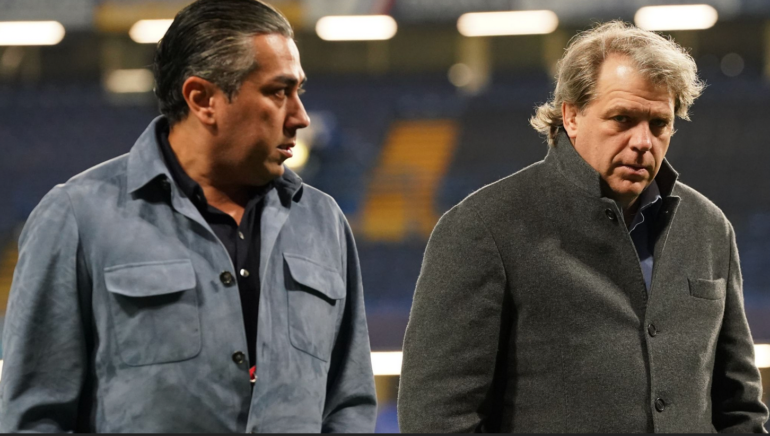
Eagle Football’s collapse exposes the systemic risks of private credit in European football. Is Chelsea next in line?
By Paul Quinn, football finance expert
This is the second part in Josimar’s dossier on the impact of private credit on European football. In the first part, Josimar broke down how private credit works.
From initial loan through to administration, Eagle Football Holding serves as an illustration of the private credit model in European football through its relationship with Ares Management, which concluded with the administration of the holding company in March 2026.
American entrepreneur John Textor acquired Olympique Lyonnais in December 2022 for approximately €800 million, funding the acquisition with private credit from Ares Management structured in multiple tranches: an initial $275 million at 16 percent and $150 million at 18 percent, all with PIK interest mechanisms that added unpaid interest directly to the principal balance rather than requiring cash payment. The total Ares exposure compounded rapidly. By late 2025, the aggregate balance had reached approximately $1.2 billion, with emergency tranches issued in July and October 2025 carrying rates as high as 19.4 percent.
The underlying logic of the PIK structure defined the trajectory. A club or holding company borrowing at 18 percent PIK does not pay interest in cash: instead, that interest is added to the principal, which then itself attracts further interest. A $500 million PIK loan at 18 percent becomes approximately $590 million after one year, $695 million after two, and over $820 million after three, without the borrower writing a single interest cheque. The lender’s exposure grows; the borrower’s equity is steadily consumed; and the conversion trigger draws closer with each compounding quarter.
In October 2025, Eagle Football defaulted on approximately $450 million owed to Ares. A 12-month standstill was granted but failed. Ares, exercising a qualifying floating charge established over Eagle’s entire undertaking, appointed Cork Gully as administrator of Eagle Football Holdings Bidco Limited in the London High Court on 27 March 2026. The appointment required no court hearing. It was executed unilaterally by Ares under paragraph 14 of Schedule B1 to the UK Insolvency Act 1986, a mechanism specifically designed for secured creditors holding such charges. Within a single business day, the ownership structure of a company controlling Olympique Lyonnais, Botafogo and RWDM Brussels had changed entirely, without any football regulator, court or governmental authority having a prior say.
The French regulatory consequences were profound. The DNCG, French football’s financial watchdog, provisionally relegated Olympique Lyonnais to Ligue 2 in November 2024 and confirmed the decision in June 2025, citing an unsustainable €175 million liquidity gap. The club’s total debt at that point stood at approximately €505 million. The relegation was ultimately overturned only after billionaire Michele Kang, already a board member of Eagle Football Group, committed substantial fresh capital alongside Ares as the de facto new controller, and assumed the role of CEO and president of the club.
The Eagle Football collapse is not a cautionary tale about reckless entrepreneurship alone. It is a case study in a private credit strategy that was always designed around the equity endpoint. Textor’s PIK debt had no credible cash-repayment path from the moment it was drawn. The PIK structure ensured that the longer it ran, the more deeply Ares’ claim embedded itself. The administration was not a failure of the strategy, but it was its conclusion.

Chelsea: a warning in plain sight
Eagle Football is a cautionary tale for another club, one that is currently competing at the highest level of European football, with apparently intact regulatory compliance and an extraordinary global commercial profile. Chelsea Football Club, acquired by Todd Boehly and Clearlake Capital in May 2022 for £2.5 billion, has since become one of the most financially anomalous institutions in world sport.
Since acquisition, Chelsea have spent approximately £1.5 billion assembling a squad, funded substantially through the holding company structure that owns the club. The vehicle at the centre of this is 22 Holdco Limited, the ultimate parent entity of the Chelsea Football Club operational group. 22 Holdco carries more than £1.16 billion of debt as of the most recently reported accounts. In 2023/24 alone, the company paid more than £94 million in interest on its borrowings.
In September 2023, Ares Management provided a capital injection of $500 million to BlueCo, the holding company owned by Boehly and Clearlake Capital that controls Chelsea FC. This facility was structured as preferred equity, a designation that performs, in substance, very much like debt. Preferred equity carries a target return, sits above common equity in any enforcement waterfall, and critically, can convert. It’s high stakes: the investor gets guaranteed payouts, total protection if things go wrong, and the ability to seize a massive piece of the club if they choose to convert their investment. The total Ares exposure at the Holdco level is approximately £410 million.
The structure has been deliberately engineered to sit outside the regulatory perimeter of the Premier League’s Profit and Sustainability Rules and the newly established Independent Football Regulator, because it is lodged at the holding company level above the football club subsidiary. This is not an accident of corporate architecture, but a deliberate feature. The same beneficially designed structure, placing the leveraged exposure above the regulated club entity, was a central characteristic of the Eagle Football / Ares arrangement at Lyon.
The financial results confirm a trajectory that demands attention. Chelsea posted a pre-tax loss of £262.4 million for 2024-25, the largest in Premier League history. Losses have exceeded £200 million across four consecutive seasons. The club requires Champions League football to generate the revenues necessary to service the cost base their owners have assembled. That is not a comfortable strategic position: it is a structural dependency on sporting outcomes, in the most competitive domestic league in the world.
The parallel with the Eagle Football situation is not speculative. Ares holds a substantial preferred equity position at Holdco level, with conversion mechanics embedded in the facility documentation. The PIK-style compounding embedded in preferred equity structures means that Ares’ effective claim grows with each accounting period in which the preferred return is not paid in cash. The holding company carries over a billion pounds of debt, the interest burden alone exceeds what some clubs generate in revenue, and the only genuine constraint on enforcement is that Ares currently has no rational incentive to enforce. Chelsea’s continued participation in the Champions League maintains the asset value that underpins their exposure.
The moment that calculus changes, two consecutive seasons outside the top four, a sustained deterioration in commercial revenues, or a breach of covenant at Holdco level, is the moment the Ares position becomes something other than patient. Ares has now demonstrated, conclusively and in the most public of circumstances at Lyon, that it is prepared to appoint an administrator with no prior notice when it judges the conditions are right. There is no reason to believe the structural protections at Chelsea are meaningfully different. The door that was wide open at Eagle Football is not obviously shut at Stamford Bridge.

The fundamental divergence
This private capital incursion into European football is frequently presented as a response to an industry in need of sophisticated stewardship. There is a grain of truth in this: some clubs were managed disastrously before their alternative investors arrived. But the narrative of rescue consistently obscures the strategy of maximum value extraction.
Private capital sponsors are able to make opportunistic deals quickly and flexibly when clubs encounter financial distress. Their ability to deploy capital fast, structure flexible financing, and absorb short-term risks gives them a distinct advantage over conventional buyers. That advantage is deployed in the interest of fund return targets rather than the sport itself. It should never be forgotten that maximising investor returns is their sole fiduciary obligation.
The clubs targeted share a recurring profile: proud, culturally significant institutions that are structurally loss-making, under-capitalised relative to their ambitions, and operating in a market where broadcast revenues have long created the illusion of sustainability where none truly exists. Private capital firms like Ares and Apollo have stepped in where banks have retreated, offering expensive but accessible capital solutions to clubs grappling with performance volatility and regulatory cost controls, with some tranches yielding over 20 percent.
The conversion-to-equity mechanism that sits at the heart of every one of these arrangements is not a safety valve for the borrower. It is the kill switch for the lender.
AC Milan, Inter Milan and Lyon have already experienced it in different forms. Atlético Madrid has been reconfigured around private credit.
AC Milan established the template. Elliott Management, a hedge fund with a long history of aggressive creditor enforcement, extended a €300 million loan to Chinese owner Li Yonghong in 2018. When Li defaulted, Elliott took the keys. Elliott’s stewardship of Milan between 2018 and 2022 is the clearest early illustration of the model at work. Elliott inherited a club with €500 million in debt, an ageing squad, and a stadium that generated a fraction of the revenue of its European peers. By the time RedBird bought it for €1.2 billion four years later, generating Elliott a profit of approximately €300 million – Milan had cleared its debt, won Serie A, and rebuilt a credible squad. The narrative that emerged presented this as a rescue. The more accurate framing is that a hedge fund lent money it expected to not be repaid, took ownership of a globally recognised football club at a distressed valuation, professionalised its operations to maximise exit value, and sold it for a substantial profit.
Inter Milan followed an almost identical script. Chinese conglomerate Suning took a €275 million loan from Oaktree during the COVID-19 pandemic. When Suning failed to repay €395 million, Oaktree took ownership of the club. The collateral backing the debt was a majority stake. The loan was never designed for repayment at par. Equity was always the goal.
Atlético Madrid presents a subtler version of the same dynamic. Ares acquired a 34 percent stake in the club’s Holdco in 2021 for approximately $217 million, positioning itself as a minority financial partner with long-term growth participation. That stake has since been restructured as part of a broader ownership arrangement involving Apollo. The club, historically the poor relation in Madrid football despite remarkable sporting achievements under Diego Simeone, has spent the better part of two decades managing a mountain of tax debt and competing on borrowed resources. Private capital has not resolved that structural weakness. It has simply refinanced it on terms that guarantee the lenders’ returns regardless of sporting outcome.
Private capital targets distressed assets with durable, identifiable revenue streams. A famous football club with a loyal fanbase, a large stadium, and a history of European competition meets every criterion. The brand cannot easily be made to disappear. Revenue, though volatile, has a structural floor, broadcast distributions, matchday income, commercial rights. The emotional importance of the club to its supporters, its city, and its national football regulator creates an implicit guarantee: no government, no league authority, and no regulator will allow a storied institution to simply fold. That guarantee is not written in any contract. But every private credit fund that has lent to European football clubs understands it to be real.
The clubs that fall into the orbit of private capital share a recognisable profile: historically significant names with revenues that have declined or stagnated; owners who are over-leveraged relative to the asset they hold; clubs that have missed Champions League football long enough for their cost base to outgrow their income; and clubs operating under regulatory pressure, from UEFA’s Financial Sustainability Regulations, from national equivalents like the Premier League’s Profit and Sustainability framework, or from domestic financial watchdogs.
This is deliberate target selection. The desperation of the borrower ensures the lender can charge whatever terms the lack of alternatives will bear. Entry at distressed valuations, with debt that compounds via PIK mechanisms and equity conversion rights embedded from day one, is the blueprint. The sport provides the asset. The financial emergency provides the entry point.
Football clubs are not corporations. They are civic institutions with century-long histories, intergenerational supporter bases, and a social function that transcends the profit and loss account. The private capital industry does not see them this way. It sees them as mispriced assets attached to durable cash flows, available at distressed valuations, with the added optionality of sporting upside.
Until the sport’s governing bodies develop the regulatory systems and knowledge to distinguish between genuine long-term ownership and sophisticated loan-to-own strategies dressed in sporting language, the predators at the gate will continue to find the door wide open.