

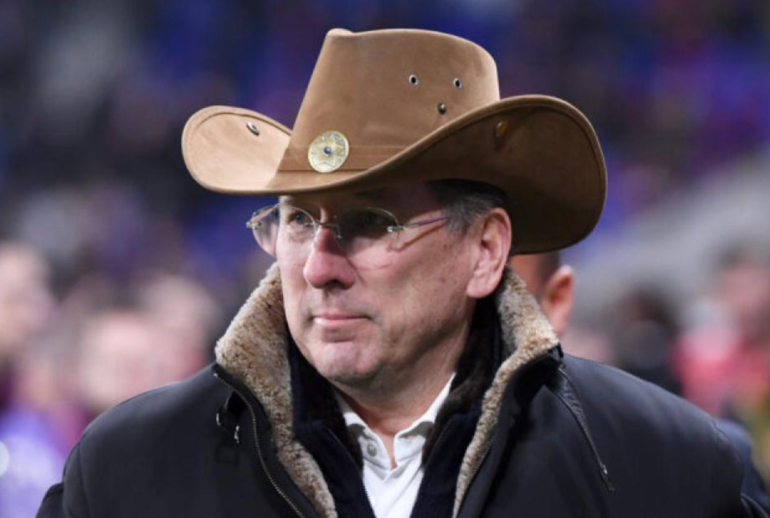
John Textor vs Private Credit

The chaotic implosion of John Textor’s Eagle Football Group is a warning sign of the growing dangers of the sport’s infiltration by the shadowy world of private credit.

By Paul Brown

This article is the first of two devoted by Josimar to the impact of private credit on football clubs. It will be followed by a case study of Chelsea FC, written by football finance expert Paul Quinn, which will be published tomorrow.

Eagle Football Group has disintegrated into a mess of warring shareholders and recriminations, dragged down by the weight of its huge debt pile. As a result, the future of Olympique Lyonnais, Botafogo and RWDM Brussels (RWDM) has been plunged into doubt, but the group’s funding model has wider implications for football as a whole.

All three clubs must now wrestle with the reality that the group’s founder, U.S. businessman John Textor, no longer controls their destiny. Instead,  they are at the mercy of the investors who backed him, and the various courts around the world in which they are fighting him. 

How did this happen, and why should football take note? In a two-part series, Josimar examines these issues.

Trophy assets

Back in the days when the Glazer family bought Manchester United and Stan Kroenke acquired Arsenal, football clubs were the ultimate trophy assets of billionaires looking for bragging rights on the golf course. 

Fans sometimes protested against such acquisitions, which were often funded in part by banks or hedge funds and loaded their club with debt. Yet, at least these owners were deeply wealthy, put in large sums of their own money, showed up at matches and wanted to bask in the glory of on the pitch successes.

They tapped into the passion of European football which suffered from chronic mismanagement, structural losses and systemic under-capitalisation. Still, many club chairmen, presidents and owners spent way beyond their means chasing silverware, television money encouraged ever-more-reckless player spending, and the structural reality, that most football clubs are loss-making entities held together by fan loyalty, broadcast revenues, and the hope of future prize money, was treated as a cultural inevitability rather than a financial emergency.

Gradually since then, a new and much more faceless class of owner has quietly infiltrated the sport – the predatory investment firm. Often mistaken as saviours, they should be understood as something considerably more calculated. As a result, many clubs are no longer treated as trophy assets by personally invested rich men but simply as one of hundreds of investments sitting on the books of multinational companies focused on extracting profit.

Sometimes, these private equity firms have bought ownership stakes outright, just as investors like the Glazers and Kroenke did. Increasingly, however, they act as lenders to football clubs, stepping in to seize control if they default on their loans. 

Private Equity and Private Credit

Private equity firms raise capital from a variety of investors and deploy it by acquiring stakes in businesses. They expect a high return, typically 15 to 25 per cent annually. 

At the same time, private equity firms manage private credit funds which lend to businesses instead of buying shares in them. These private credit funds often target distressed businesses – including football clubs – which commercial banks have turned their backs on. They do so in a deliberate “loan-to-own” strategy, knowing these companies may default. In exchange, they charge extraordinary rates of interest, commonly 10 to 20 per cent or more annually. If the borrower defaults, they have the contractual right to convert the debt into equity. 

That conversion right is not incidental. It is the engine of the entire business model. Nowhere has it been deployed more consequentially than in European football, where a growing number of clubs have been seized by private equity firms as collateral on loans.*

The largest players in this space are household names in institutional finance, if not in the stands at Old Trafford or the Emirates, and included among them is Eagle Football’s biggest creditor, Ares Management.** 

These firms are among the most sophisticated financial operators on the planet. But they are coming under increased scrutiny for their lending practices, as cracks begin to appear in their business model.

Since the Great Financial Crisis (GFC) of 2008, the private credit industry has ballooned into a $3 trillion global market. But a series of high-profile bankruptcies, rising defaults and valuation concerns has sparked a rush of investors trying to exit the very private credit funds operated by firms which lend to football clubs. That is not always easy, as funds can “gate” redemptions, limiting the amount investors can withdraw at any one time.

Michael Burry at a screening of The Big Short.

Market heavyweights like Jeffrey Gundlach and Michael Burry see a private credit bubble waiting to burst based on excessive risk-taking. Gundlach is convinced investors are going to lose money, while Burry, who successfully predicted the 2008 crash and ended up becoming one of the stars of Hollywood blockbuster The Big Short, has predicted “the end of the road” for the sector. 

Cockroaches? What cockroaches?

It’s not just investors waving red flags. A recent poll of Global Fund Managers conducted by Bank of America listed private credit as one of the top five risks to the global economy. In its April 2026 Global Financial Stability Report, the International Monetary Fund warned that “high-profile defaults” in the private credit sector “suggest loose lending standards and insufficient due diligence.” Bank of England Deputy Governor Sarah Breeden has warned that a loss of confidence in the sector could trigger a banking crisis similar to 2008 and JPMorgan CEO Jamie Dimon has issued repeated warnings that recent bankruptcies in the sector may not be isolated cases, saying that “when you see one cockroach, there are probably more.”  

When it comes to potential cockroaches in the space where the worlds of football and private credit collide, one stands out. Eagle Football Group was once touted as a successful Multi-Club Ownership (MCO) operation which held stakes in Crystal Palace, Olympique Lyonnais, Botafogo and RWDM. But Eagle’s shareholders are now at war with each other in courts in three different countries, and the group has collapsed into insolvency. In March, its holding company was placed into administration in the UK “following events of default” related to a loan from private equity giant Ares, one of the world’s largest private credit managers with $644 billion in total assets under management as of March 31, 2026.

To understand why this happened, and what it reveals about football’s infiltration by private credit, it is necessary to look closely at one man: John Textor.

John Textor at a Brazilian Parliamentary Commission of Enquiry.

Where Eagle dares

An extended member of the Du Pont family, one of the richest in America, Textor is often described as a billionaire, but does not appear on the Forbes list of the world’s richest 3,412 people to qualify for that status.

Textor made his early wealth investing in internet and entertainment companies, along with a visual effects studio, before moving into football. In August 2021, he acquired a 40% stake in Crystal Palace. In December 2021, he purchased an 80% stake in RWDM, and a month later added a 90% stake in Botafogo to his portfolio. Eagle Football was then formed in November 2022 and a month later it acquired a 78% shareholding in OL.

Eagle was designed to be an interconnected network of clubs with players and cash moving freely around the group as part of an internal revenue-sharing agreement.

But all of this was only made possible with the help of a huge cash influx from the private credit market in the form of three loan notes provided by Ares Management totalling $425,000,000. Those notes carried steep Payment-In-Kind (PIK) compounding interest rates ranging from 16% to 18%. PIK interest is a financing feature where instead of being paid in cash, the interest owed is added to the principal balance of the loan. Compounding rapidly increases the total debt owed, requiring a much larger lump sum or refinancing at the loan’s maturity, and because lenders take on the risk of not seeing any cash until the end of the loan term, PIK instruments carry higher interest rates than standard loans.***

From the very beginning, the structure of this initial financing essentially guaranteed that Eagle’s debt burden would outpace its operational revenues. By mid 2025, more funding was required, and Ares provided another loan note, this time worth $102,372,900 with a PIK rate of 19.4%. A final round of emergency funding was provided in October 2025 worth up to $20,000,000, again with a PIK rate of 19.4%. 

By then, however, the game was up for Textor, because Eagle was accruing annual interest on these loans of approximately $76.5 million, an almost impossible figure for the clubs to service. As a result, Eagle’s total debt burden ballooned, with the company owing Ares an estimated $1.2 billion. 

Textor was forced to sell his stake in Crystal Palace to repay some of the money he owed. This was the first clear sign of Ares moving to protect its investment by activating a series of security pledges tied to its loans.

This manoeuvre came as no surprise. Corporate filings in the U.S. show that the private equity firm has been forced to mark down the value of some of the loans provided to Eagle several times to as low as 17 cents on the dollar. 

Exercising its governance rights, Ares formally removed Textor from the board of Eagle’s holding company in January 2026, and, as a result of what it claimed were multiple “events of default”, the firm took more unilateral action on March 27, placing the company into administration in the UK. 

Textor said he was “gravely offended” by that decision, which he labelled “predatory”. London-based Administrators Cork Gully are legally required to liquidate Eagle’s stakes in its football clubs, but it seems likely this could result in the splintering of the group and differing outcomes for each club, with OL the only asset Ares seems intent on protecting and managing, at least for now.

Chaotic backdrop

All of this is unfolding against the chaotic backdrop of legal claims and counter-claims in various jurisdictions. Another Eagle shareholder, Iconic, is suing Textor in London for $97 million claiming he failed to honour a contract to buy back their minority stake in Eagle if the company was not floated on the stock exchange. 

Botafogo launched a legal claim against OL for the return of $178.8 million which the club says was sent to France and never returned. Textor has also submitted a legal complaint in France aimed at Ares and another Eagle shareholder, Michele Kang, the current chair of OL, essentially accusing them of mounting a coup to remove him from power. OL is facing a $63 million lawsuit in the London Commercial Court brought by factoring company PRPF over payments related to the transfer of Igor Jesus. 

In addition, a Rio court has suspended Eagle’s voting rights at Botafogo, which has been placed into judicial recovery, a legal process allowing the club to renegotiate debts with creditors under court supervision. Textor was ousted from his position as a director at Botafogo in April, but a power struggle for control of the club continues, with the American attempting a comeback. Sources in Brazil claim Ares has reached a settlement with the club which could result in it being sold to GDA Luma Capital, an investor which specialises in distressed assets, but this has yet to be confirmed. Botafogo are also currently unable to sign new players after being hit with a fifth FIFA transfer ban over unpaid debts.

Meanwhile, in Belgium, RWDM filed a similar petition for judicial reorganisation with the Brussels business court to stave off bankruptcy, having had their licence to operate in the Challenger Pro League revoked. The club has until June 29 to find a new owner and renegotiate its debt. 

RWDM’s Edmond Machtensstadion.

Whatever happens next, Eagle’s downward spiral into chaos clearly illustrates why owners who take out big private credit loans to run their football clubs do so at their peril, and why the influx of this kind of lending into the game carries big risks. 

Authorities in both football and banking certainly have concerns. Josimar understands that fears about such lending to clubs by predatory private equity firms have been raised with the UK’s new Independent Football Regulator, which is looking closely at the issue. The Bank of England is currently conducting a “stress test” into the risk the sector may pose to the wider health of the UK’s financial system. And Treasury Secretary Scott Bessent recently met with state regulators in the U.S. to discuss the life insurance industry’s growing exposure to the sector.

Zombie companies

How many football clubs are potentially exposed to private credit? Research by PitchBook shows that more than 36 of the clubs in Europe’s five biggest leagues now have private equity, venture capital or private debt participation through majority or minority stakes, including a majority of clubs in the Premier League. But many more rely on financing from private credit funds. Some of the world’s biggest private equity firms, including Ares, Apollo, CVC Capital Partners and KKR have set up funds to invest widely in sport. When it comes to football, PitchBook Senior EMEA Private Capital Analyst Nicolas Moura told CNBC last August that U.S. investors find the MCO model particularly attractive, even though operators like Eagle have failed so spectacularly at it. 

Some of these private credit titans are so big their revenue dwarfs the GDP of many small nations. But are they too big to fail? Ares Management raised $113.2 billion in new capital last year alone, investing $145.8 billion globally. But its flagship private credit vehicle, the Ares Strategic Income Fund, has not been immune to the growing jitters of investors, receiving redemption requests for 11.6% of its shares in the first quarter of 2026. At the time of writing, the stock price of the company as a whole has fallen 26% this year. Other private equity firms have also seen their share price slip.

In another sign of turbulence, the Financial Times reported that JPMorgan, America’s biggest bank whose CEO Jamie Dimon issued that warning about cockroaches, is looking to offload risk tied to more than $4 billion in loans to private equity funds hoping to cut its exposure to “an industry grappling with a prolonged slowdown.” Japan’s largest lender, Mitsubishi UFJ Financial Group, is likewise trying to offload risks tied to loans to private credit funds. 

Ares and other private equity firms are lending to, and buying up, more and more companies. But they are finding it increasingly difficult to sell them on. Football clubs could risk becoming just like these “zombie companies”, barely able to generate enough cash to service their debts and unable to attract buyers even at a discount. 

The private credit funds these firms employ also have a limited lifespan, often as short as eight years. At maturity, they need to sell the companies they have invested in to return capital to their limited partners. What happens if a large number of private equity investors seek to exit their football investments at the same time? And what happens if there are no buyers?

What is happening at Eagle should be a warning of what can go wrong when the worlds of football and private credit collide. But will the sport’s lawmakers take the risks seriously? 

*Elliott Investment Management took control of AC Milan in 2018 after the club’s Chinese owner failed to repay debt, and in 2024, Oaktree Capital Management seized Internazionale Milano under similar circumstances

**Other notable players in this market include Apollo Global Management, which bought a majority stake in Atlético de Madridand has loaned 80 million USD to Nottingham Forestin July 2025. But strategies often differ depending on the firm. BDT & MSD Partners were an early and aggressive mover in lending to clubs. CVC Capital Partners bought perpetual stakes in league commercial vehicles, locking in revenue streams before they reached the clubs themselves. Rights and Media Funding pursued comparable infrastructure lending against broadcast receivables


***For example, a $500 million PIK loan at 18 percent becomes approximately $590 million after one year, $695 million after two, and over $820 million after three, without the borrower writing a single interest cheque. The lender’s exposure grows; the borrower’s equity is steadily consumed; and the conversion trigger draws closer with each compounding quarter.

Zeen is a next generation WordPress theme. It’s powerful, beautifully designed and comes with everything you need to engage your visitors and increase conversions.