
Correspondence between the Premier League and the British government suggests that, contrary to expectations, elite English football clubs will be allowed to pursue commercial relationships with illegal betting operators in the future.
By Philippe Auclair
It had been hoped that the 2026-27 season would see a decisive shift in English football’s relationship with the gambling industry, both legal and illegal. Britain’s Labour government had promised it would review the current arrangements after the 2024 general election and act “robustly” to ensure the mistakes of the past would be corrected. The new “Independent Football Regulator” (IFR) Bill received royal assent on 21 July 2025, describing one of its key tasks as “to protect and promote the financial soundness of regulated football clubs”, which one would have thought included making sure that the money which these clubs receive from commercial partners is of legitimate origin.
In February and May of the same year, the Great Britain Gambling Commission (GBGC) had issued stern warnings to seven Premier League and Championship clubs sponsored by unlicensed operators. “We would advise that any organisation engaging in sponsorship from brands that do not hold a Commission licence manage their exposure to risk”, the British gambling regulator said. “This includes satisfying themselves as to the source of the funds for the arrangement”.
One of the worst offenders, Isle Of Man “White Label” company TGP Europe, which hosted British domain names for at least nineteen Asian-facing illegal operators (*), and which Josimar established had direct links with jailed Macau crime boss Alvin Chau, surrendered its British licence after being handed a 3.3 million pounds sterling fine by the GBGC. Last and certainly not least, clubs would no longer be able to display the names of betting operators on their shirt fronts as of the start of the 2026-27 season. There are eleven of them today, seven of which (*) are illegal operators.
That was the good news. Now for the not-so-good update: that shift won’t happen.
The U-turn
Correspondence between the Premier League and Baroness Twycross, the British Minister for Gambling and Heritage, obtained by CEGA (Coalition to End Gambling Ads) under the UK Freedom of Information Act and passed on to Josimar, shows that, far from preventing elite English clubs from taking the money from illegal operators, both league and government have reached a consensus: let them carry on.
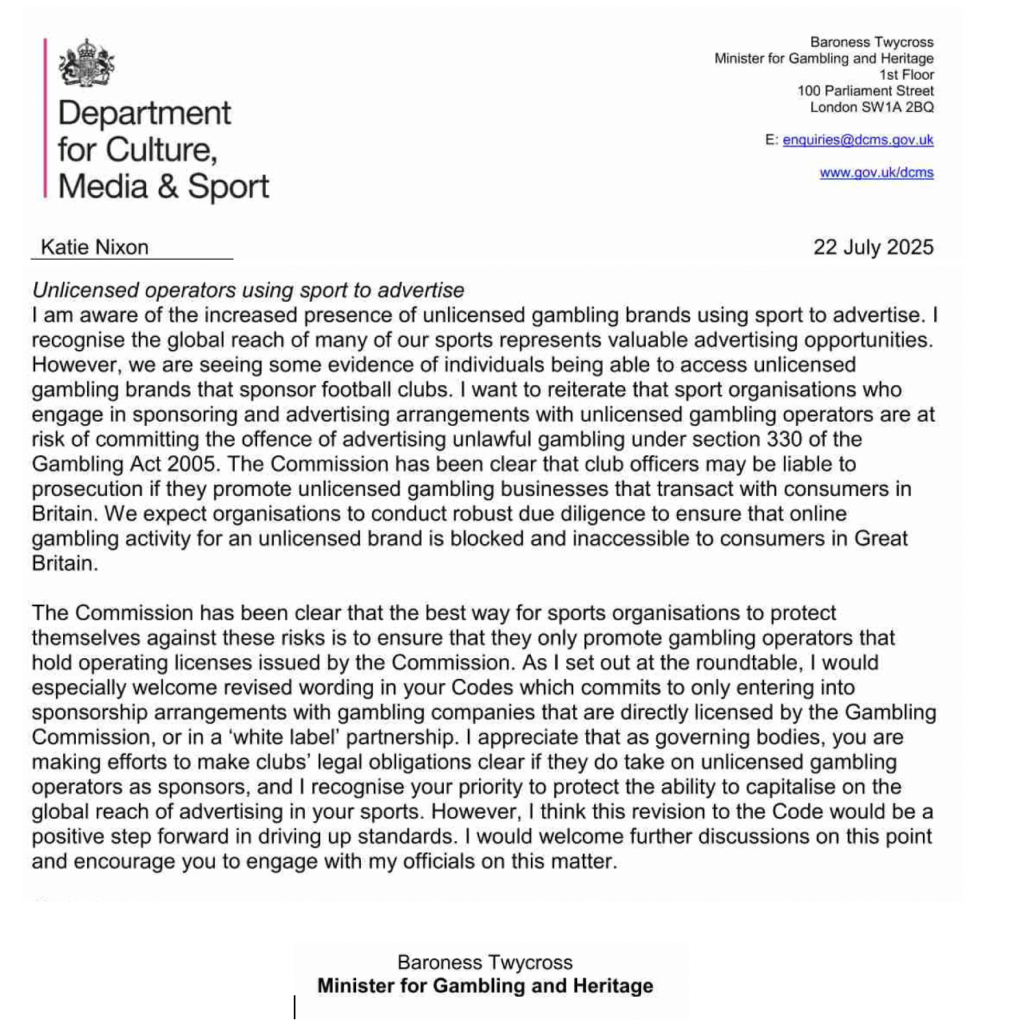
Letter dated 22 July 2025 from Baroness Twyford, Minister for Gambling and Heritage, to Katie Nixon, Head of Public Affairs of the Premier League.
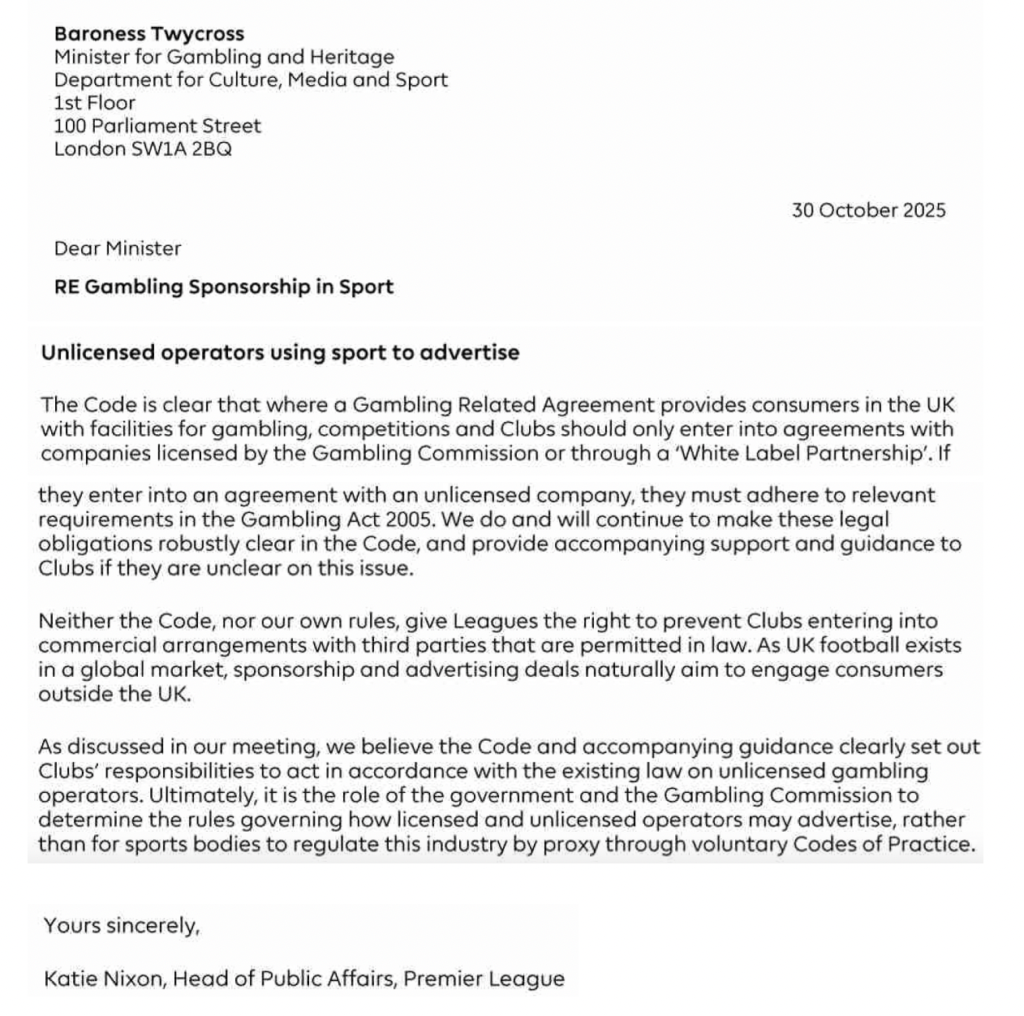
Letter dated 30 October 2025 from the Premier League’s Head of Public Affairs Katie Nixon to Baroness Twycross, UK Minister for Gambling and Heritage.
There is no need to read between the lines here. Katie Nixon and Baroness Twyford are singing the same tune from the same hymn sheet. As the Premier League has a “global appeal” (its games are broadcast live in over 200 territories, more than there are members of the United Nations), “sponsorship and advertising deals naturally [our italics] aim to engage consumers outside the UK”, Nixon says, echoing the “valuable advertising opportunities” mentioned by Twycross.
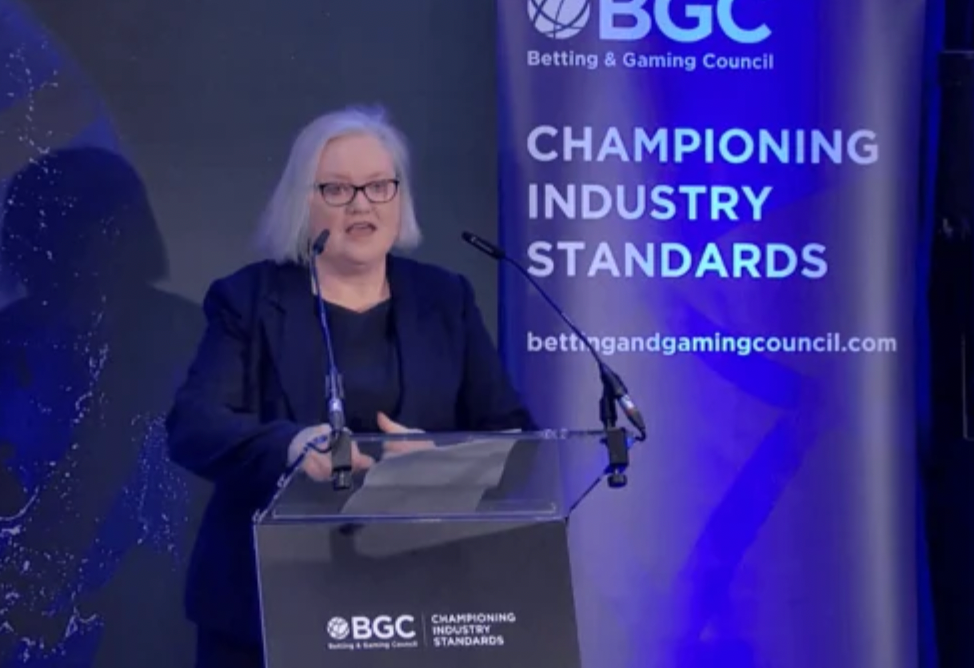
Baroness Twycross delivered a keynote speech at a conference organised by the British gambling industry organisation and lobby group Betting & Gaming Council in February 2025.
So what to do, when these advertising opportunities mean taking money from Asian-facing companies operating illegally, at least two of which, as reported by Josimar, have been linked to human trafficking and cyber slavery: 8XBet (current partner of five PL clubs: Chelsea, Bournemouth, Sunderland, Leeds, Nottingham Forest) and BK8 (Burnley)?
Turning a blind eye
The answer is: so little as equating to nothing. There is no mention of new, more “robust” regulations or possible punishment for infringements. In this, the PL and the British government are following the Gambling Commission’s lead. The GBGC used to insist that online gambling companies which partnered with British football clubs should at least have a UK domain name. This explains why those operators (all of them unlicensed and illegal in their target Asian markets) used the services of White Label providers such as TGP Europe to acquire one. They no longer need to. The clubs concerned now only need to satisfy themselves that these operators are not targeting and cannot be accessed by UK-based customers. In this respect, it may come as a surprise, or not, that neither Nixon nor Twycross mention the existence of Virtual Private Networks (VPNs) in their correspondence, which make it child’s play to circumvent geo-blocking, a surprising omission when recent studies show that UK residents are among the top users of VPNs worldwide.
More to the point, whatever happens beyond UK borders appears to be of no concern to the British authorities, despite the overwhelming evidence linking illegal online gambling operators to organised crime, people-trafficking and appalling human rights abuse, as reported by the United Nations Office on Drugs and Crime and Amnesty among others.

Scam centre and illegal gambling kingpin of the Prince Group Chen Zhi (centre) escorted by Chinese SWAT officers at his arrival in Beijing on 8 January 2026.
This is in contrast to what happened in Germany last December, where Bundesliga club Borussia Mōnchengladbach terminated its partnership with AYX (also a former partner of Monaco, AS Roma and Atlético de Madrid) after the broadcast of an incriminating documentary by national network ZDF. It is not as if the Premier League, the GB Gambling Commission and the British government are unaware of the nefarious, indeed criminal nature of the illegal Asian-facing gambling industry. As widely reported in the UK press, the scam center baron Chen Zhi, also a kingpin of illegal gambling, who was arrested in Cambodia and extradited to China after the US and British authorities investigated his Prince group, owned homes worth over 100 million pounds sterling in London. British Foreign Secretary Yvette Cooper said: “the masterminds behind these horrific scam centres are ruining the lives of vulnerable people and buying up London homes to store their money”. Quite. They know.
Yet the suffering endured by the 200,000+ people who have been lured to Cambodian scam compounds, only to be brutalised and enslaved, does not seem to be a cause for concern, as it doesn’t involve British citizens. It doesn’t seem to matter either that it is suspected that the millions paid out by illegal operators to the English football clubs which promote their brands are the proceeds of crime and that, therefore, these football clubs risk being complicit in money-laundering.
Nor does it matter that some of those illegal operators have been found to offer bets on blood sports and livestream hardcore sex content to their customers, as evidenced by Josimar in the case of Crystal Palace’s partner NET88.

Crystal Palace partner NET88 advertising a hardcore sex livestream on its Facebook Page (post now deleted) in March 2024.
See no evil, hear no evil
As to the “due diligence” which the GBGC, the PL and the government insist is necessary, the onus is put on the clubs themselves and them alone to carry it out. It is deemed enough by both the PL and, more to the point, the British government, that these clubs should be reminded of their responsibilities and conform to the recommendations of the Code of Conduct. But it is up to them, and no-one will ensure they do: this is self-regulation in the strictest sense. Now what are the chances that a Premier League football club owned by profit-seeking investors, most of them from the USA, would waste cash on investigations which they know will show that their potential partner (and its millions) should be shown the door?
There is no mention of any auditing, scrutiny process or external oversight, not even when it comes to money flows, a glaring omission when football clubs still do not have to abide to the same AML/FOT rules as other businesses do and will not have to until 2029 at the earliest. Here again, clubs only have to “satisfy themselves” that they are doing what is asked, ever so gently, of them.
Perhaps the most extraordinary suggestion made by Baroness Twycross concerns the use of “white label” partnerships. Her response to Katie Nixon first appears to draw a line in the sand which clubs should do their best not to cross. They should commit “to only entering into sponsorship agreements with gambling companies that are directly licensed by the Gambling Commission”. Fair enough. Then comes the implausible addition “or in a ‘white label’ partnership” [our italics].
It can only be surmised that Baroness Twycross was not briefed as comprehensively as she should have been on the subject. The very idea that White Label status provides some, any kind of guarantee as to the legal nature of an online operator is delusionary, when White Labels were set up precisely to trump the system and enable unlicensed operators to fool regulators and customers into believing that they were legitimate and provided a safe gambling environment.
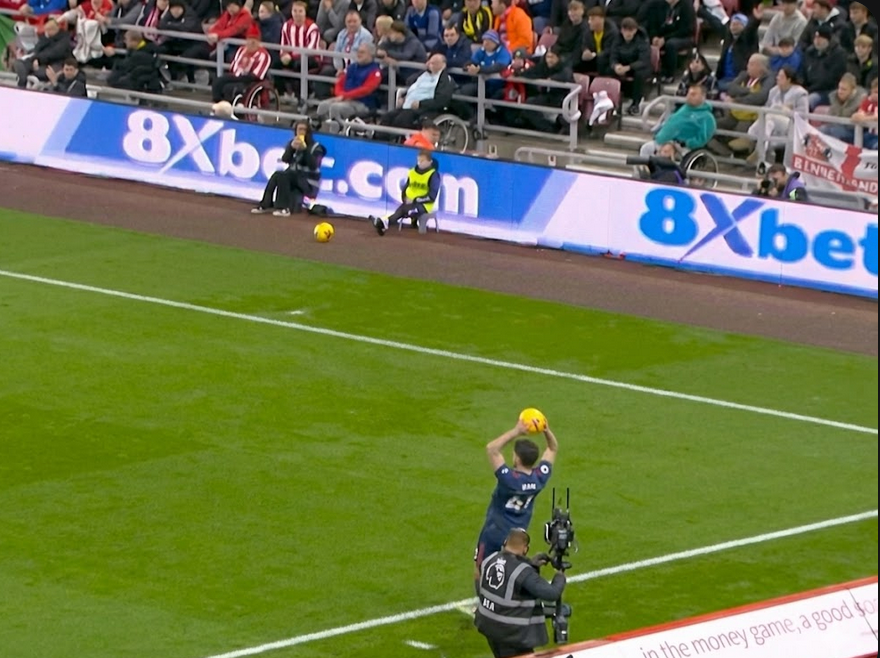
Illegal Asian-facing operator 8XBet advertisement on the perimeter boards of Sunderland’s Stadium of Light, 8 November 2025.
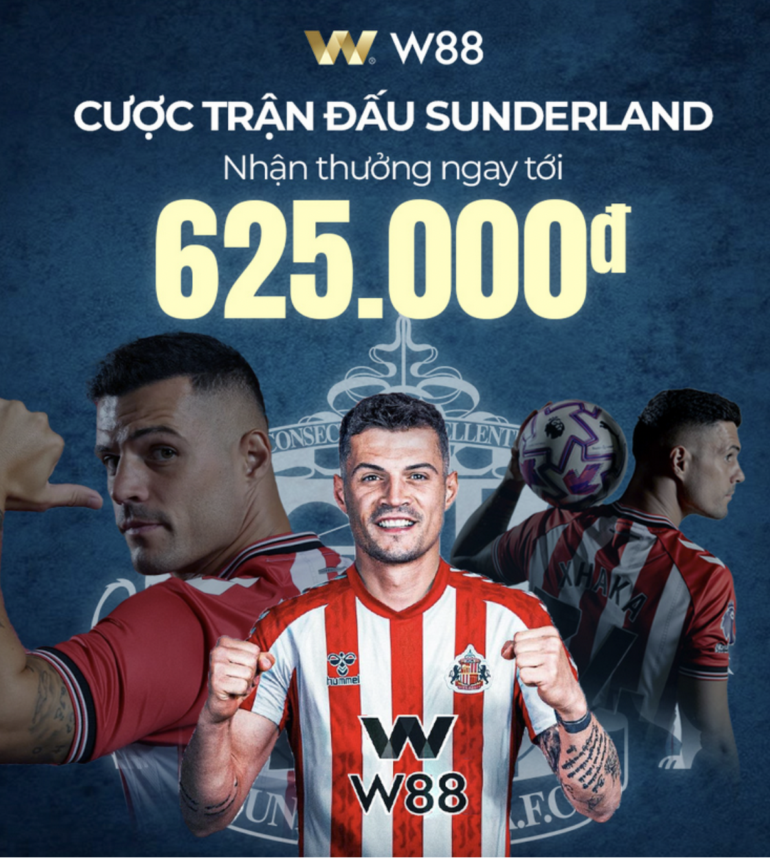
The end result? PL clubs have prepared themselves for the “ban” on gambling advertising on the front (but not sleeves) of shirts which will come into force in August 2026. Many of them have already moved on to different types of sponsorships, mostly involving displays on LED perimeter boards in their stadiums. Sunderland have six of those deals in place, two of which were struck with illegal operators W88 (also their main sponsor for the 2025-26 season) and the cyber slavery-linked 8Xbet. Aston Villa promotes the equally illegal Nova88 in their arena, Brentford FUN88, and so on.
Many others will imitate them without fear of rebuke, safe in the knowledge that the British government will not lift a finger – unless it is to bless them.
(*) 12bet (partner of Wigan, Coventry, Hull, Swansea, Wolves, Arsenal, West Brom, Leicester, Leeds, Crystal Palace); 138.com (Watford, Newcastle); 6686 (Leicester, Nottingham Forest, Wolves); 8Xbet (Manchester City, Leicester, Ipswich, Chelsea, Bournemouth, Sunderland, Leeds, Nottingham Forest); 96.com (Burnley); BC.GAME (Leicester); BK8 (Aston Villa, Burnley, Huddersfield, Crystal Palace); FUN88 (Tottenham, Newcastle, Burnley, Brentford); HTH (Manchester United, Leicester); i8 (Everton); Kaiyun (Chelsea, Leicester, Aston Villa, Crystal Palace); LeTou (Swansea); Leyu (Chelsea, Leicester); OB Sport (Aston Villa, Leicester); SBOTOP (Fulham, Leeds, Swansea, Norwich, Hull, West Ham, Southampton); TLCbet (Middlesbrough, West Bromwich Albion, Southampton); UK-WL (Nottingham Forest); Yabo (Manchester United, Leicester).
(*) Bournemouth (BJ88), Burnley (96.com), Crystal Palace (NET88), Everton (Stake), Fulham (SBOTOP), Sunderland (W88) and Wolverhampton Wanderers (DEBET). Josimar uses “illegal betting” as defined by Article 3 of the Macolin Convention, of which the UK and Norway are both signatories.