
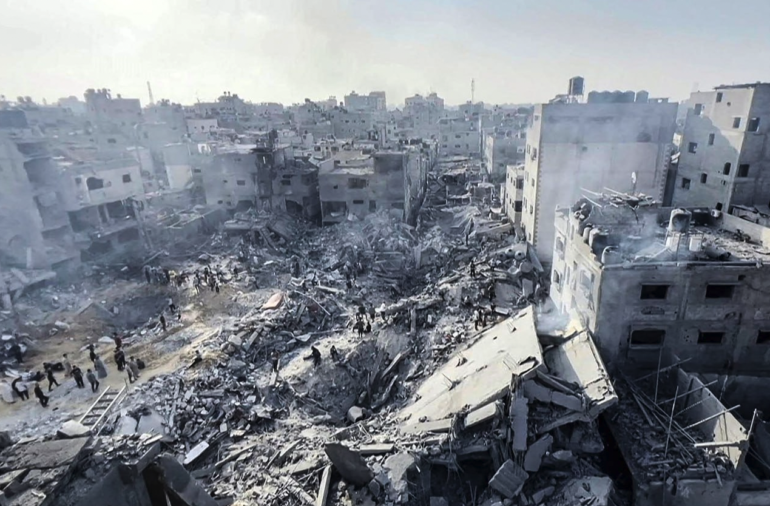
The global governing body preaches global unity, yet it consistently ignores and mishandles the Palestinians.
By Nick McGeehan, director at FairSquare
There will come a day – and let us all hope that day comes soon – when people struggle to recall the name of the Fifa President, and the occupant of that position confines herself to sober and sensible comments in her regular press conferences. Until then, we will have to put up with the increasingly deluded Gianni Infantino, a man who has been so brainwashed by his own PR that he can claim that Fifa has been “the official happiness provider for humanity for over 100 years” while openly consorting with a cabal of the world’s most powerful and corrupt demagogues. Among those who would take strong issue with Infantino’s sunny assessment of FIFA’s contribution to humanity are, of course, the Palestinians.
As global attention turns to the 2026 MAGA World Cup, it’s important to address Fifa’s gross mishandling of the Palestine issue. In March, Fifa published the decisions of the two committees that its leadership had charged with handling long-standing complaints of the Palestinian Football Association (PFA). It’s Fifa’s latest cack-handed attempt to sweep the issue under the carpet, but inconvenient as it may be for the world’s official happiness provider, occupation, apartheid and genocide aren’t easily resolved, and Fifa’s latest judgments will not extricate the organisation from the mess in which it has found itself.
The Palestine Football Association has been complaining to Fifa since 2013 about the Israel Football Association (IFA) allowing matches to be played in illegal Israeli settlements in the West Bank, and in March 2023 the PFA submitted a new complaint on the issue to Fifa, tacking on a complaint about systematic racial discrimination. FIFA has been kicking the can down the road ever since, presumably because it is fully aware that the IFA is in clear breach of Fifa rules that prohibit member associations from playing games on the territory of another member association without their permission.
In October 2024, Fifa announced that its Governance Committee would address the complaint about illegal settlements, and that its Disciplinary Committee would handle the complaint about racism. It took the Governance Committee a subsequent 17 months to arrive at the following 40-word conclusion, buried in a press release titled ‘FIFA Council highlights power of football and the FIFA World Cup to build bridges and promote peace.’
“FIFA should take no action given that, in the context of the interpretation of the relevant provisions of the FIFA Statutes, the final legal status of the West Bank remains an unresolved and highly complex matter under public international law.”
The Disciplinary Committee, by contrast, took only 10 months and published a 40-page report that not only castigates the Israel Football Association’s record on tackling racial discrimination, but also seriously undermines the Governance Committee’s dismissal of the complaint about illegal settlements.
Paragraph 107 of the Disciplinary Committee’s judgement refers to the restriction of movement of Palestinians in the West Bank and notes that “football clubs in these settlements serve only Israelis, excluding Palestinians from participating as players, spectators, or youth participants.” and cites as one of its sources a seminal judgment (in the form of an ‘advisory opinion’) from the International Court of Justice in 2024.
The ICJ judgment concludes not only that the Israeli settlements in the West Bank are illegal under international law (a finding that confirms two UN Security Council resolutions and a previous 2004 judgment from the court), but Israel’s presence itself is unlawful and must be brought to an end “as rapidly as possible”. Not only does the Disciplinary Committee cite the ICJ as a source, but in paragraph 110 it describes its conclusions as “compelling”.
Now, for the avoidance of any doubt, the Disciplinary Committee is talking about systematic racial discrimination, not the illegality of the occupation, and it explicitly notes this in its report.
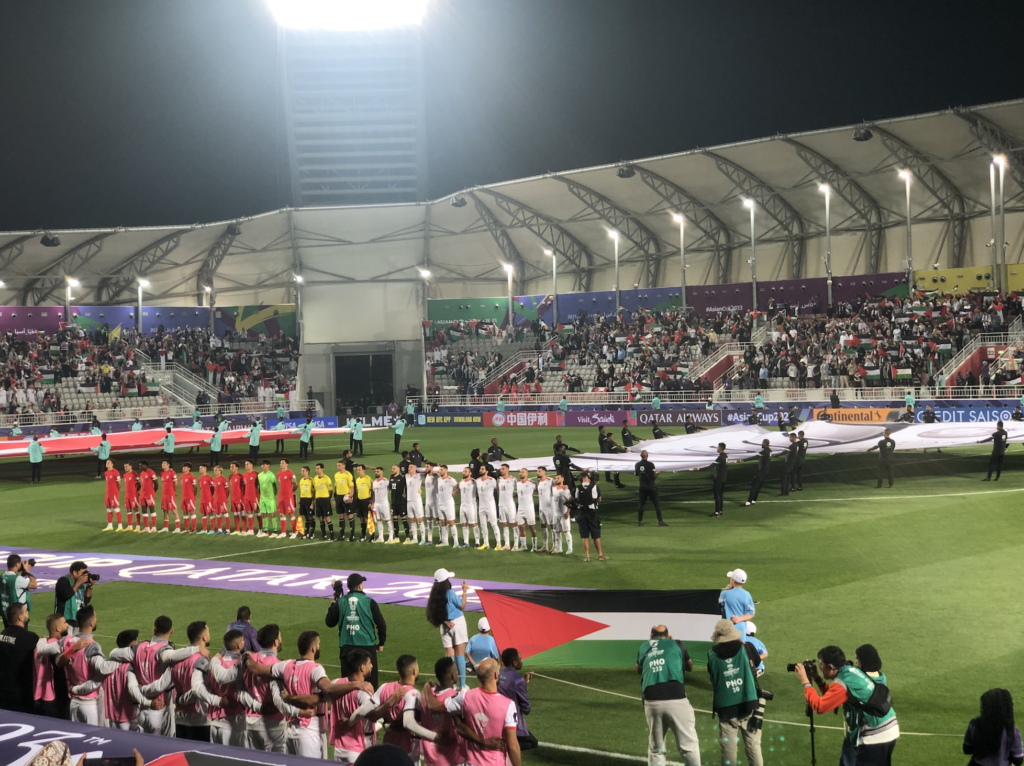
However, the extent to which these issues can be disentangled is highly questionable – the ICJ based its finding of overall illegality in large part on the pervasive racial discrimination by Israel towards the Palestinians. Even if you were to separate the issues, there remains a bizarre discrepancy in the way FIFA committees are operating. One FIFA Committee charged with handling one of the issues in the PFA’s complaint referred to the most credible and authoritative sources of international law in arriving at its conclusions. Whereas another committee, dealing with another issue in the same PFA complaint concocted its own legal assessment.
It is regrettable that only a few figures in the sports media have chosen to engage with the findings of the Disciplinary Committee because they have much to add to the debate on racism in Israeli football that has made headlines in the UK and Europe due to the furore over Maccabi Tel Aviv supporters and the fall-out from the violence that erupted in Amsterdam in October 2024.
The Disciplinary Committee says that “the IFA’s conduct has brought football into disrepute, both domestically and internationally, and has damaged public trust in the sport’s ability to serve as a force for peace and inclusion”; that the IFA “failed to take meaningful action against Beitar Jerusalem FC—a club whose supporters have engaged in persistent and well-documented racist behaviour”; that the IFA sent “a message of institutional tolerance rather than deterrence”; that the IFA “has brought the sport of football into disrepute” and “tarnished the reputation of football in the region and beyond”; and that the IFA “has become institutionally complicit in a system that violates the core values of the game” and has damaged “the moral authority of football as a tool for social cohesion and intercultural dialogue.”
Of course Fifa being Fifa, it stopped short of actually sanctioning the IFA in any meaningful sense – the IFA was fined only 150,000 Swiss francs and ordered to hoist a “Football Unites The World – No To Discrimination” banner at the next three home matches of the national team. And Fifa has not explained why it waited seven months to publish the findings of the Disciplinary Committee.
The PFA is now taking its case to the Court of Arbitration for Sport (CAS), where it is challenging Fifa’s dismissal of its settlements complaint. Any challenge will face the hurdle that are CAS’s absurd procedural rules, but if the PFA can overcome these its legal team will surely highlight the fact that the Fifa Disciplinary committee referred to international law, while the Fifa Governance committee wilfully misrepresented it. It remains to be seen if the PFA has the resolve to assemble the type of complaint that has a serious chance of holding Fifa accountable. The Disciplinary Committee’s judgment should also be of keen interest to the football clubs in Ireland who forced the Football Association of Ireland to formally call for the IFA’s suspension from Uefa. That call is in large part rooted in Uefa’s rules mandating member associations enforce strict rules and policies on racial discrimination. In that regard, Fifa’s Disciplinary Committee has rather thrown Uefa under the bus.
Where Gianni Infantino is concerned, the plight of the Palestinians is just another opportunity for him to vaunt his skills as a peacemaker and happiness-provider. At the Fifa Congress in Vancouver in April, Infantino tried – and failed – to get the heads of the Palestinian and Israeli football associations to shake hands on stage. In a gleeful Instagram video he posted in February, on the day that Fifa signed a formal agreement with Trump’s Board of Peace, Infantino briefly put on his serious face to note that the focus of his message was “obviously Gaza”. The video continues with AI-generated imagery of a child carrying a ball through bombed out rubble, a Fifa-sponsored artificial pitch with an apocalyptic backdrop, and players training on an artificial pitch in front of a construction site. “When it comes to rebuilding a country after a conflict, you don’t just have to build houses, roads, hospitals and schools, you also have to build emotions, and football is about that,” says Infantino. If Infantino ever subjected himself to press conferences, one obvious question for him would be how he squares his belief in the restorative power of football pitches with his Disciplinary Committee’s finding that “even attempts to include Palestinian children in sports programmes have failed due to permit issues and political pressure.”
If you want a picture of the future, imagine a boot stamping on a human face— forever, wrote George Orwell. And if you look closely at this picture, you can see Gianni Infantino in the background. He’s standing on a 5-a-side pitch in Gaza wearing white trainers and a MAGA hat, and it looks like he’s saying “football unites the world”.
Josimar will regularly open its columns to independent guest contributors who wish to comment on the most pressing issues in world football. These columns solely reflect the opinion of their authors. Their publication does not constitute an endorsement on Josimar’s behalf, but a way to encourage and promote debate within the football community.