
By ignoring and even actively worsening the climate crisis, Fifa is failing its mission statement – to make the game global and ensure a sustainable future for the sport.
Op-ed by Frank Huisingh, Fossil Free Football
Saudi state oil company Aramco’s latest rebranding campaign wields the slogan “Powered by How.” So what does Aramco’s “how” mean in practice? It means drilling and selling oil, and doing whatever it takes to protect the demand for fossil fuels.
“How” means lobbying, sponsoring, marketing, closing deals with developing countries and thwarting climate action, including at UN climate conferences. The PR-campaign portrays the oil giant as a global innovation company. Aramco’s biggest sports sponsorship deal, so far? Fifa. In 2024, the oil giant struck a deal, thought to be worth 100 million US dollars a year, to headline Fifa’s competitions.
Aramco had multiple reasons to sponsor Fifa to enhance its reputation, as this piece by DeSmog laid out. Oil companies are unpopular as people experience the climate crisis’s deadly consequences. There is a growing public demand for stronger action to combat climate change and to address issues of affordability. Fossil fuel is facing fierce competition from ever cheaper solar power and electric vehicles. Aramco – desperate, ruthless and incredibly rich – felt threatened and decided to fight back. While CEO Amin Nasser told the world at a fossil fuel conference to “abandon the fantasy” of phasing out fossil fuels, a PR-campaign would target consumers and ensure that the – inevitable – phase out will occur as slowly as possible.
The Fifa sponsorship is about associating Aramco with Kylian Mbappé, not wildfires; with Erling Haaland, not floods; with Cole Palmer, not deadly heat. It draws on a familiar playbook from the tobacco industry, combining aggressive lobbying of both politicians and policy makers, and misleading the public. For tobacco, this strategy worked for decades, until their power was successfully challenged and advertising and sponsorship deals were eventually banned under European and global conventions.
We’re not there yet when it comes to fossil fuels. Instead, we’re in the midst of an existential fight between public opinion calling for climate action and the deep-pocketed fossil fuel corporations determined to protect their profits. They found an ally in the leadership of the world’s biggest sport – ever hungry for cash and expansion and determined to hold on to power. The current state of play is striking: while humanity arguably faces its biggest shared threat, football, the world’s number one cultural phenomenon, has picked the side of those causing it.
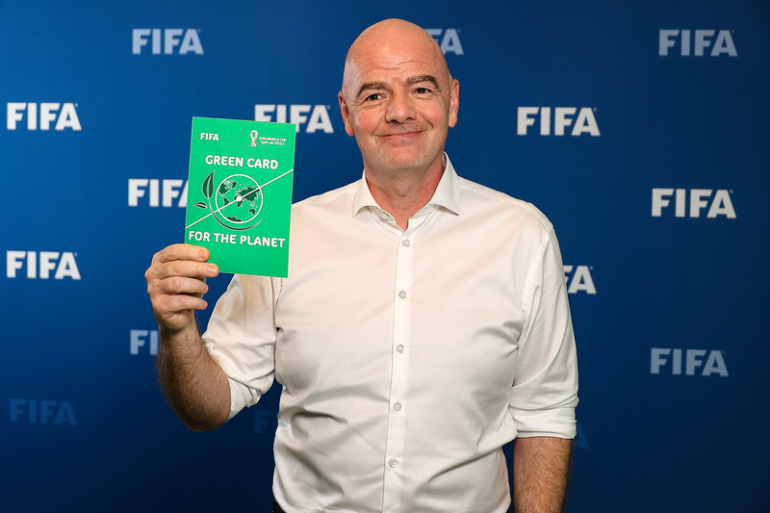
This is not what Infantino promised us. He raised a “green card for the planet” on World Environment Day. Fifa signed the UN Sports for Climate Action Framework which sets ambitious objectives: halving emissions by 2030 and reaching net-zero by 2040. Signatories should promote “responsible consumption”. In order to meet those objectives, Fifa would have to seriously rethink and reorganise the football calendar. It would have meant smaller, and more regional competitions. Fifa has only moved in the opposite direction – pushing endless growth at the expense of player health, fan excitement and the long-term future of the game.
Football’s climate commitments are not optional, they are about the sport’s self-preservation. Table tennis and badminton may not be directly threatened by climate change but an outdoor sport like football is threatened in its existence on a planet that is simultaneously getting hotter, wetter and drier.
The evidence is overwhelming. An assistant referee collapsed at the 2024 Copa America due to extreme heat, which also forced Uruguay defender Ronald Araujo to be substituted, and led to widespread concerns among players. The 2025 Club World Cup, also in the US, was disrupted by extreme heat, with substitutes forced to stay inside due to 30°C average gametime temperatures, teams compelled to cut training sessions short and players asking to be subbed. Enzo Fernandez, who went on to win the tournament with Chelsea, said: “Honestly, the heat is incredible. I had to lie down on the ground because I was really dizzy. Playing in this temperature is very dangerous.”
This summer, the heat risks for the 2026 World Cup will be similar. Research predicts that 14 out of 16 venues are likely to exceed dangerous heat thresholds. Fifa has delayed kick-off times and will use covered stadiums in scorching host cities Kansas City and Dallas. But even northern cities like Philadelphia and New York experience dangerously high summer temperatures. There, matches are scheduled during the hottest hours, in stadiums offering almost no shade, putting players and fans at real risk.
Cooling breaks during each half may provide some relief for players, but they offer insufficient protection against the risks of intense heat and humidity. World players’ union FIFPRO says that Fifa’s heat protocols fall short of scientifically recommended standards. Play will be slower and players risk exhaustion, dehydration and even heat stroke. Fifa is ignoring the risks and prioritises revenues over player safety.
Player health is paramount but the heat also poses a great risk to the fans when congregating downtown and commuting to stadiums. At last year’s Club World Cup, fans even filed complaints with Fifa Human Rights Complaints Mechanism to voice their concerns about dangerous heat exposure.
The impact of climate change will be even more dramatic at the grassroots level. Increasingly, matchdays are being canceled due to floods. Local football pitches have to compete with agriculture for water. As a result, kids are confined indoors instead of playing football on their neighborhood pitches.
By ignoring and even actively worsening the climate crisis, Fifa is failing its mission statement – to make the game global and ensure a sustainable future for the sport.
In a different world, football would be at the forefront, advocating for climate action. It’s not difficult to imagine what that advocacy would look like. We already have Thomas Müller advertising heat pumps, now think about Kylian Mbappé campaigning for better public transport and Moises Caicedo demonstrating how his youth football club has become more sustainable. They would receive a global applause because climate action enjoys more support than generally estimated.
Instead, we are now with fossil fuels where we once were with tobacco. Despite clear evidence of the harm caused by its products, the industry has doubled down on its disinformation strategy. The “How” campaign is a telling example.
Johan Cruijff once featured in a tobacco advertisement. When he got ill from smoking, he became a vocal anti-tobacco campaigner. Soon, Scott McTominay and others will battle in the summer heat on pitches with Aramco advertising panels. Every single player at the World Cup will have to endure it. Some are already very concerned, whereas others – receptive to the adage that they should focus only on football – still live in blissful ignorance of the grave risks. Either way, it’s hard to imagine that any player will enjoy a World Cup in suffocating heat against a backdrop of hoardings screaming the logo of the very company most responsible for it.
Josimar will regularly open its columns to independent guest contributors who wish to comment on the most pressing issues in world football. These columns solely reflect the opinion of their authors. Their publication does not constitute an endorsement on Josimar’s behalf, but a way to encourage and promote debate within the football community.