
Saudi Arabia wants a repeat of the Qatar World Cup – little or no accountability over the treatment of migrant workers. The Arab Kingdom is not shy to intimidate unions to get a current complaint at the International Labour Organization (ILO) dropped.
By Sam Kunti
“It’s intimidation,” Joel Odigie tells Josimar. The secretary general of the International Trade Union Confederation (ITUC) Africa does not mince his words towards Saudi Arabia and its recent alleged conduct toward the powerful union that represents 191 million workers around the globe. In a recent report, Saudi Arabia singled out Odigie by name, which he argues is part of a larger pattern of intimidation.
Why is Saudi Arabia allegedly intimidating a union leader eight years before holding the World Cup? In a complex web of bureaucratic procedures and legal arguments, the Arab Kingdom is already maneuvering to spin the narrative around migrant workers and labour reforms ahead of the 2034 tournament, a World Cup that will require construction of infrastructure on a monumental scale. To do so, they are taking a leaf out of Qatar’s playbook.
Mustafa Qadri of NGO Equidem explains: “Saudi Arabia is trying to speed-walk us towards where Qatar eventually went, claiming, with the support of the ILO, that kafala had ended. Do you know the movie Groundhog Day, where a man repeats the same thing over and over again? It sounds a lot like the previous World Cup and the run-up to it.”
To host the 2034 World Cup, Saudi Arabia is undertaking a slate of mega projects: 15 brand new or re-purposed stadiums, a desert city, a mega airport and a general overhaul of its infrastructure. Under economic pressure, the Arab Kingdom may not complete all of these projects, most notably the sci-fi city of Neom, but, even so, the burden to transform the country will fall on migrant workers from southeast Asia and Africa.

Artist’s impression of the projected 2034 World Cup Murabba Stadium, Riyadh.
They will toil in the heat to build the hotels, airports and shining football temples. Last year, Josimar detailed the fate of Bangladeshi workers who went on strike in Neom after their wages were not paid. They were dismissed there and then. A Pakistani engineer died on site, but his family had to fight to receive any compensation.
The scale of construction will dwarf Qatar’s $220 billion transformation ahead of the 2022 World Cup, the first global football finals to be held in the Middle East. In Saudi Arabia, migrant workers make up a third of the population. They often hail from under-privileged backgrounds with limited understanding of the few rights they have in Saudi Arabia. Sometimes, they might not master Arabic. Often, they are not digitally literate.
Saudi Arabia does not want a repeat of the global onslaught Qatar faced from media and human rights groups over the abuse of migrant workers. Yet, the country already faces scrutiny. In two separate complaints lodged with the ILO, a United Nations organisation, the unions have accused Saudi Arabia of widespread migrant worker abuse, including forced labour, discrimination and wage theft. In June 2024, Builders and Wood Workers International (BWI), part of the Global Union Federation, filed a complaint under article 24 of the ILO Constitution.

BWI delegates presenting their complaint at the ILO headquarters, Geneva, 5 June 2025.
A year later, BWI and ITUC joined forces to file another complaint, this time under article 26 of the ILO Constitution. The complaint detailed systemic abuse, including passport confiscation, debt bondage and 18-20 hour workdays, primarily concerning African workers employed in the construction and domestic sectors.
ITUC General Secretary Luc Triangle said: “Trade unions are calling on the ILO Governing Body to establish a Commission of Inquiry, the ILO’s most serious and far-reaching accountability mechanism. The scale and severity of violations demand this. We cannot tolerate the death of another migrant worker in Saudi Arabia.”
Odigie tells Josimar: “When the complaint was filed successfully, Saudi Arabia engineered all manner of diplomatic, political and administrative pressure on all the countries from the global south that signed.”
Earlier this month, in response to the article 26 complaint, Saudi Arabia objected to the accusations, denying that it violated ILO conventions. The Arab Kingdom argued – almost ad nauseam over 64 pages – that it engages in social dialogue and has rolled out a robust legislative framework. The mere existence of legislation, Saudi Arabia appeared to suggest, was enough to exonerate the country from labour violations perpetrated on the ground.
Odigie, the secretary general of ITUC Africa, rubbishes those arguments: “If the Saudis [had] done excellent work in terms of the reform, it would be a thing of pride to tell people to come and see it, and test it. They are afraid for people to interrogate [what they have done]. How are you in dialogue when you are conducting reprisals against the people you are supposed to talk to? What kind of dialogue is that? They have previously intimidated some African governments.”
At the same time, Saudi Arabia said that the sample of violations the unions invoked was simply too small. They went a step further and claimed that nine years ahead of the World Cup, kafala – the infamous labour system prevalent in the Gulf, that gives employers almost unchecked powers over migrant workers – had been replaced by ‘a modern mobility framework’. The Saudis point to 88 cases of forced labour complaints the local authorities received between 2024 and 2025.
The Saudis accused ITUC of a ‘confrontational approach’ and took aim at Odigie, the general secretary of ITUC Africa, for making a ‘diatribical’ remark when he said that ‘workers are being treated as disposable in Saudi Arabia. They leave alive and return in coffins.’
It is highly unusual for a state to single out a trade unionist, but also part of a larger pattern of intimidation against ITUC Africa, the union argues. Odigie doesn’t want to go down without a proper fight. He calls Saudi Arabia’s targeting “a political and administrative fatwa”. “Anywhere you see this guy, get him.”

ITUC-Africa General Secretary Joel Odigie
He says: “I will not back down. Let people say that Africa’s black lives do not matter, that they are expendable people who can deal with that, that we are slaves, we will tell them we are not. We will tell them that our brothers and sisters that have died will get justice and those that are still living and working must stay alive.”
Odigie says that other members of ITUC Africa have been targeted.
The complaint under article 24 that centered on the non-payment of 20,000 migrant workers is working its way through the ILO mechanisms, but the second complaint – under article 26 – could lead to the establishment of a Commission of Inquiry, the highest action in the ILO universe. It comes with a cost of $500,000, a substantial sum for a cash-strapped organisation.
Yet Saudi Arabia just needs to look across the border to understand how to deal with the tripartite system of unions, member states and the ILO.
In 2014, Qatar found itself on the back foot. The narrative around the World Cup was beginning to shift from concerns over alleged corruption, climate and football culture to the plight of migrant workers. Even worse, two powerful unions, BWI and ITUC lodged a complaint with the ILO and accused the Gulf nation of “widespread and systematic violations” of labour conventions. Three years later, Qatar promised reforms and the complaint was dropped.
The kafala system was abolished on paper and the ILO started trumpeting Qatar’s labour reforms. However, Josimar reported on the ground over several years and found that the labour reforms were paper ones – they had not been implemented.
To this very day, recruitment fees, passport confiscation, lack of health insurance, long working hours, unsanitary accommodation, wage theft and lack of legal representation remain rampant in Qatar. Unions are still prohibited and the right to strike does not exist.
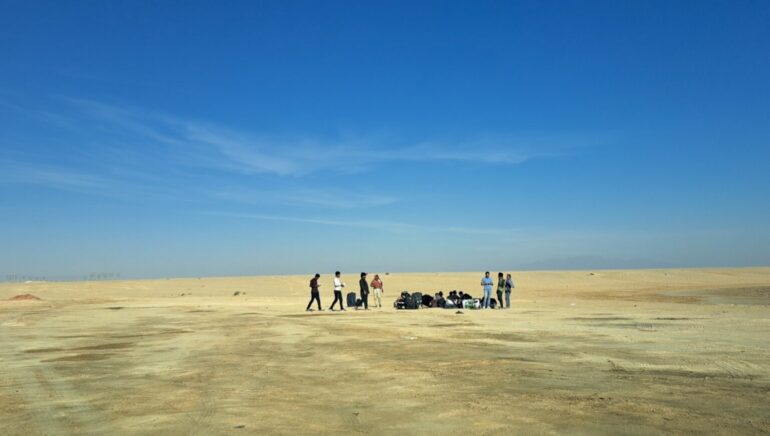
Two years after the World Cup final, Shahin, a migrant worker from Bangladesh, found himself in the Qatari desert selling second-hand electronics. He was still waiting to receive outstanding wages for helping build Lusail Stadium. Last year, a Josimar investigation found that migrant workers, out of work following the post-World Cup construction slump, were being recruited by the Russian army, often by deceit, as cannon fodder.
Football itself turned its back on the migrant workers in Qatar. After the global finals, only the football associations of Norway, Denmark and the Netherlands returned to Qatar. FIFA, the governing body, delivered the ultimate blow, ignoring a recommendation of its own subcommittee to provide migrant workers or their families with compensation. In an act of ‘blue washing’, FIFA lavished a $50 million legacy fund on the WTO’s Weide Fund and UNHCR and WHO. Not a single cent was spent on migrant workers.

Saudi Arabia’s World Cup bid included a human rights assessment by law firm AS&H Clifford Chance, a Riyadh-based branch of the global Clifford Chance partnership. NGOs and rights groups rubbished the assessment because it “whitewashed” labour abuses and scrutinized only human rights instruments that Saudi Arabia had ratified. Odigie and ITUC Africa wrote to FIFA to demand oversight of Saudi projects, but the world governing body rejected the request. Still, FIFA awarded the 2034 World Cup to Saudi Arabia.
Qadri believes FIFA are not just complicit but sending a chilling message: “FIFA will hire legitimate human rights experts who genuinely want to make a difference, but the leadership never speaks to people on the ground. They’re creating an alternative reality, which is full of process and paperwork. I can’t help but conclude that that is by design, not by fault. They deliberately create a complicated bureaucratic process to which you engage with human rights experts while in reality, FIFA is needed to make money on the back of exploiting workers, partnering with organizations and regimes with really terrible human rights records.”
“We’ll partner with you as long as there’s money to be made. There are no repercussions on you politically or economically for doing the wrong things.”
The ILO’s role has remained controversial all along. In his book ‘Still Work To Be Done’, trade unionist and former ILO Chair Luc Cortebeeck recalls how Qatar lobbied the ILO on a mission in Doha and used diplomatic back channels: “The Prime Minister gave us a friendly welcome, but he soon turned to Japanese ambassador to the United Nations Misako Kaji: ‘Madam Ambassador, you do know that the Emir and my government have excellent trade relations with your country, Japan, especially for the supply of natural gas? And Mr Cortebeeck, you do know about our good trade relations with Belgium and that we supply gas to the LNG terminal in Zeebrugge?”
In 2017, when Cortebeek became the chair of the UN body, Qatar and the ILO aligned. The Gulf nation funded the Doha-based ILO office with a $25 million contribution. In a 2021 report, the ILO wrote that Qatar had introduced “comprehensive” labour reforms, language that typified the organisation’s minimisation of the situation on the ground. Weeks before the World Cup, former PM of Togo Gilbert Houngbo, recently elected to the position of ILO’s Director-General, commended Qatar’s progress, arguing that, “Many lessons can be drawn from these labour reforms.”
In 2023, Qatar’s labour minister Ali bin Samikh Al Marri, linked to the Qatargate bribery scandal in the European Parliament, was appointed chair of the International Labour Conference (ILC) despite objections from rights groups, raising concerns about the ILO’s claimed neutrality and transparency. The ILO renewed its technical cooperation with Qatar in March 2024, while the program’s evaluation report simultaneously noted that “The Evaluation Team met with workers’ representatives. The evaluation did however not manage to interview workers directly. It was therefore not in a position to collect inputs from the more than 2 million workers in Qatar.”
An ILO report from February 2026 showered Qatar with praise, highlighting “reforms…that have transformed the country’s labour landscape…unprecedented policy milestones.” It disclosed that Qatar has supported the ILO office in Doha with a budget of $39,9 million since 2018. The report failed to address the state of affairs on the ground: minimum wage, freedom of association, legal representation and other pressing matters for workers.
Saudi Arabia has promised $4 million to the ILO as part of the third cooperation partnership. Sources claim that the Arab Kingdom will lavish the UN body with many more millions in the future.
The ILO’s funding – through mandatory contributions from member states and voluntary contributions – has become fragile after the US government of Donald Trump cut its funding by $107 million. The US has still not settled more than $170 million in arrears from 2024 and 2025 and the position of ILO deputy director-general remains vacant. The organisation is considering eliminating 120 positions or, in a more stringent scenario, 350 positions.
That financial fragility could be exploited by Saudi Arabia. “At the time of publication of this document, the parties to the complaint have resumed dialogue with the intention of reaching an agreement on a possible framework for cooperation,” reads the Saudi response to complaint under article 26. It’s a single line that crystallizes the direction of travel – Saudi Arabia wants – and will – get the complaint dropped.
“It’s not about having an agenda against Saudi Arabia,” concludes Qadri. “It’s about an estimated 11 to 15 million migrant workers with debt bondage from the poorest regions of the poorest countries and to ensure that they have basic rights, that they can just get paid what they’re owed, that they have basic dignity.”
Saudi Arabia’s Ministry of Human Resources and Social Development has been contacted for comment.