
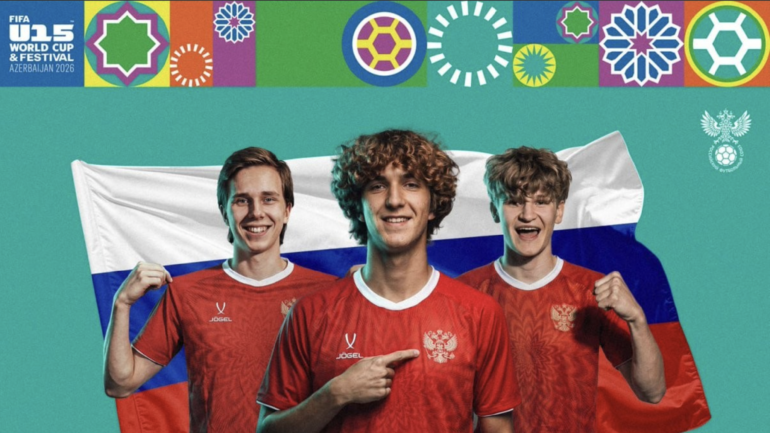
As Russia intensified its attacks on Ukraine in late October, Gianni Infantino’s Fifa quietly took its first step toward Russia’s sporting rehabilitation, allowing a U15 team to compete under its own flag.
By Philippe Auclair
On 25 June 2026, a day on which Russian ballistic missiles rained on the Ukrainian capital Kyiv, causing the death of at least seven civilians, Fifa’ Bureau of the Council announced that “teams of all member associations” would be invited to take part in Fifa’s inaugural U15 World Cup and Football Festival, which concluded in Azerbaijan two weeks ago.
Russia was not named; but everyone understood what “all member associations” stood for. Immediately after Putin’s tanks crossed the border, several European federations, including England, Poland and Sweden, indicated they would refuse to play against Ukraine’s aggressor. Fifa, which initially favoured a partial ban – no flags, no anthems, no official jerseys, “home” games played in neutral venues – bowed to the pressure; but whilst Russian men’s and women’s teams of all age groups were banned from international competitions, Russia remains a full member of both organisations, enjoying the same rights and privileges as any other national football federation.
On 1 July 2026, a week after the statement of the Bureau of the Fifa Council was made public, forty-four Members of the European Parliament wrote to Gianni Infantino and asked him to reconsider the decision to welcome Russia back into the fold of the “football family”. “While Ukrainian children are deprived of so many things”, the MEPs said, “including sporting activities, due to the destruction of schools and sports stadiums, and while around 20,000 Ukrainian children have been forcibly kidnapped and separated from their families by Putin’s regime, we do not consider it appropriate to allow Russian teams to participate in any Fifa events”.
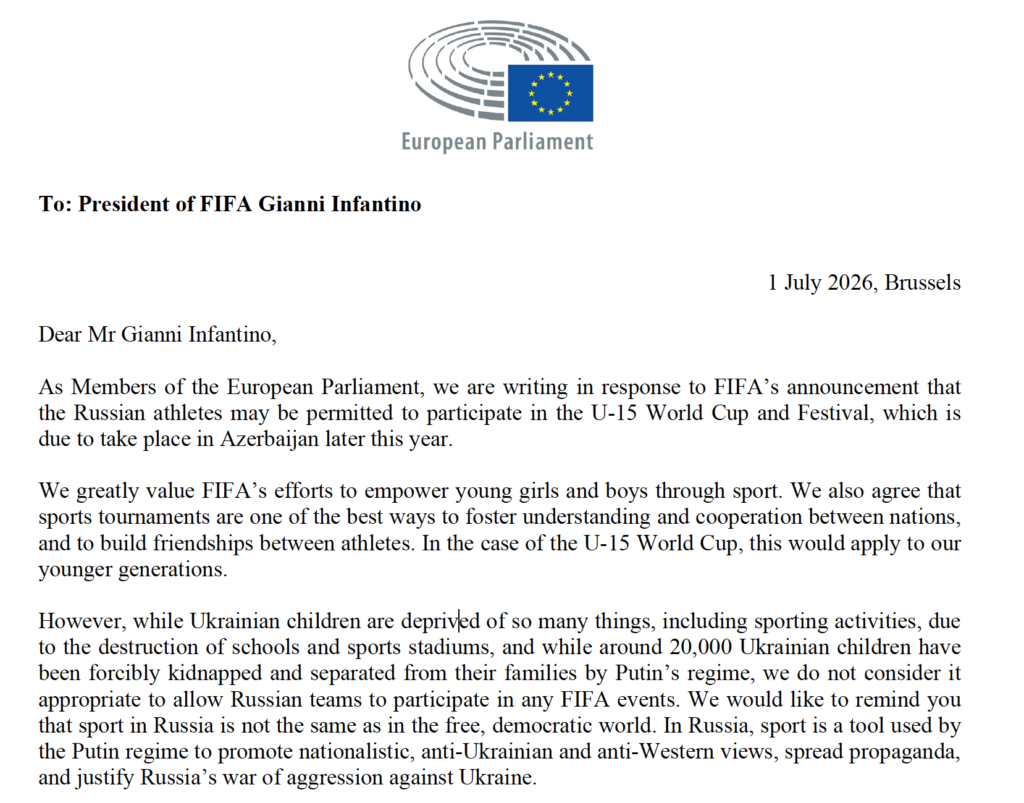
Their words fell on deaf ears. It is true that they were unlikely to sway a Fifa president who, five months previously, had told a Sky Sports interviewer that the Russian ban “hadn’t achieved anything” and only “created more frustration and hatred”.
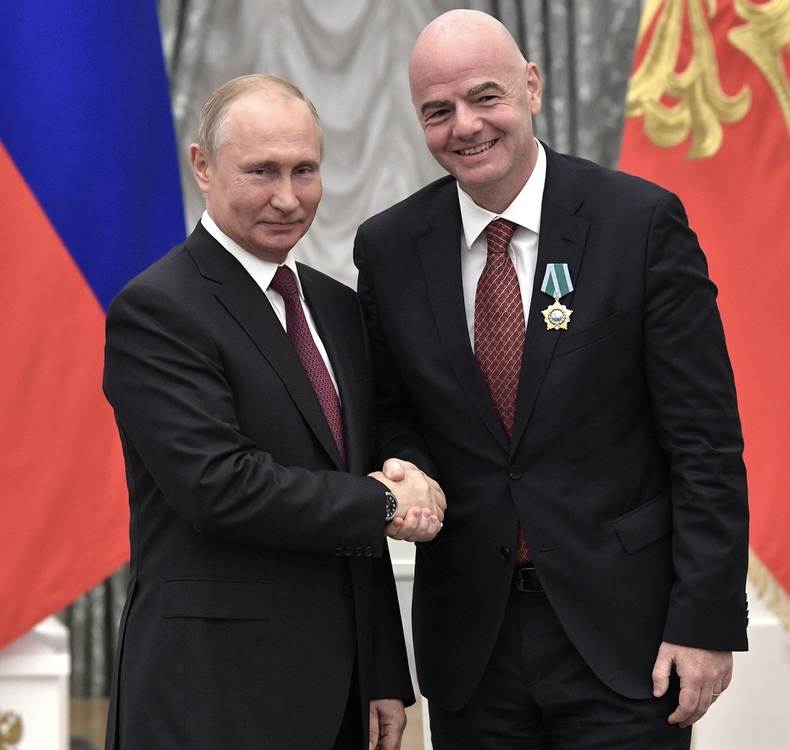
Warming up to his theme, the recipient of the Russian Order of Friendship had carried on in the same vein. He’d expressed the wish to see Fifa “enshrine in [its] statutes” a new rule, which would forbid the organisation from ever banning any country from playing international football “because of their political leaders”. This was music to the Kremlin’s ears. “Our footballers, our national team, must have their rights fully restored”, Putin’s spokesman Dmitry Peskov said. “We hope that sooner or later such discussions will take place in Fifa”.
They did; and the result was that Russia, almost unnoticed, was brought in through the back door. “Somebody needs to keep the ties open”, Infantino said. “Having girls and boys from Russia being able to play football games in other parts of Europe would help”. But help whom? Vladimir Putin’s regime, without a doubt, for whom, to quote the MEPs’ letter, “sport is a tool used […] to promote nationalistic, anti-Ukrainian and anti-Western views, spread propaganda, and justify Russia’s war of aggression against Ukraine”.
The Russian Football Union (RFU), Russia’s football federation, was delighted that its representative U15 team would be allowed to compete under the nation’s flag, spurred on to the field by the stirring accents of Alexander Alexandrov’s national anthem, as the RFU stressed in an official statement published on its website.
So the “boys from Russia” (the “girls” will have to wait) duly took part in Fifa’s inaugural U15 World Cup & Football Festival, in which 189 Fifa Member Associations from all six confederations took part from 24 to 30 October in Azerbaijan; and, once there, performed as well as their coach, former CSKA Moscow defender Denis Pervushin, could have hoped. They won their group convincingly and finished 19th in the tournament’s final rankings, with a record of eights wins, one draw and one defeat, against Mexico. Fifa ensured that the Russians would not have to play against inconvenient rivals. The only UEFA nation they faced throughout was Türkiye, a country which has tried to maintain a pragmatic balance in its response to the war in Ukraine.
Ukraine itself withdrew from the tournament in protest to Russia’s presence and called on its allies to do the same. Some (eighteen in total, all of them European) heeded the call and stayed away altogether, like Germany, Belgium, Romania and all of the Scandinavian nations. Poland took part but indicated that it would “not take the field if it [faced] Russia or Belarus in the playoffs of the FIFA U-15 World Cup & Festival 2026 tournament in Azerbaijan”. Others ignored Ukraine’s request, most noticeably France and the four Home Nations, England, Wales, Scotland and Northern Ireland. FA president and Fifa Council member Debbie Hewitt made no public comment either on England’s presence in Azerbaijan or on Russia’s reclaiming a place in Fifa’s “football family”.
It was obvious that, for Russia, this U15 World Cup represented stage 1 in their country’s full rehabilitation, following the International Olympic Committee’s betrayal of Ukraine in early July 2026, which many international sports governing bodies (*) took as a licence to unroll the red carpet for the return of Putin’s sporting ambassadors. After his players won their group in the qualification stage of Fifa’s U15 tournament, Pervushin expressed the hope that that tournament would be the first step towards the full return of Russia to international competitions. It would have been difficult to state what the real objectives of the Russian delegation at Fifa’s U15 jamboree were more clearly; objectives which happen to align exactly with Gianni Infantino’s own plans. In March 2027, a vote for Infantino will also be a vote for Russia.
(*) Namely fencing, modern pentathlon, table tennis, archery, judo and taekwondo. Wrestling, weightlifting, aquatics and gymnastics had lifted their ban on Russia in the late spring of 2026.