

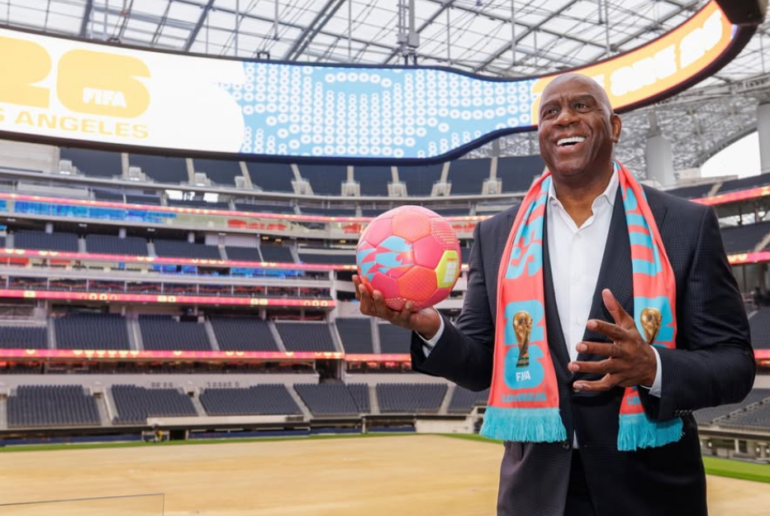
Chelsea co-owners Mark Walter and Todd Boehly are trying to sell. But a federal investigation into Walter involves a company long tied to sporting icon Magic Johnson, who owns football teams of his own.
By Paul Brown
Earvin ‘Magic’ Johnson is basketball royalty. One of the greatest to ever play the game. His flashy skills, infectious enthusiasm and contagious smile made him the face of the NBA for years as his ‘Showtime’ LA Lakers dominated the sport in the 1980s. He later wowed the world in a leadership role alongside Michael Jordan and Larry Bird on the ‘Dream Team’ which swept the USA to a historic gold medal at the 1992 Olympics.
But since his retirement, Johnson has been on another team altogether. It’s here that his story becomes indelibly interwoven with two billionaires who pioneered a new way to fund the purchase of some of the world’s biggest sports teams – Mark Walter and Todd Boehly.
Earlier this week, Walter hit the headlines by agreeing to a sudden sale of the Lakers to Josh Kushner and Bob Iger for 12.5 billion USD amid a probe into his business affairs by US prosecutors. Then, along with his long-time business partner Boehly, he suddenly decided to explore the sale of his shares in Chelsea to the Premier League club’s majority owners, Clearlake Capital.
Josimar has already detailed Walter’s need for cash after he was forced to reclassify more than 20 billion USD in private credit investments held by his insurers. The investigation into the 66-year-old centres around whether he or his companies committed fraud by concealing financial connections while borrowing billions of dollars from those insurers. Boehly is not under federal investigation but faces increased scrutiny from US state regulators over the dealings of his own insurance companies.
So where does Magic Johnson come in? To find the answer you have to go back to 2015, when the retired Lakers superstar purchased a majority, controlling interest in EquiTrust Life Insurance Company, which at the time managed 14.5 billion USD in annuities, life insurance and other financial products. Johnson bought EquiTrust from Guggenheim Partners, whose CEO was, and still is, Mark Walter.
One of four companies probed
EquiTrust’s valuation rapidly increased and by 2023, when Johnson officially became a billionaire, it accounted for the majority of his wealth. Then, in November 2025, Johnson sold the company to an investment firm called Amistad Financial.
According to the Wall Street Journal, Amistad Financial is one of the four businesses tied to Walter that the US Attorney’s Office is investigating, and its purchase of Johnson’s EquiTrust came two months after Walter had his phone and laptop seized by the FBI as part of the probe into his business empire.
It’s understood Johnson no longer owns a stake in EquiTrust. But Eric Holoman, who is President and CEO of EquiTrust and the managing founder of Amistad, remains a managing partner and investment committee member at JLC Infrastructure, an asset management firm formed in 2015 by Loop Capital and Magic Johnson Enterprises (MJE). Holoman also holds a leadership position at Loop Capital, and served as the former president and CEO of MJE.
Johnson did not immediately respond to questions when contacted by Josimar for this story.
The 67-year-old’s links to Walter and Boehly at Guggenheim actually predate his purchase of EquiTrust, but they remain rooted in the world of life insurance. In 2012, the three men were part of an investment group which purchased the prestigious LA Dodgers baseball team. Josimar has written about how a class action lawsuit brought two years later against Walter and Boehly accused them of using Guggenheim Insurers as a “cash cow” to help fund the Dodgers acquisition. EquiTrust is one of the insurers named in the lawsuit. The docket for the lawsuit says it was voluntarily withdrawn but the forensic accountant who helped build the case told Josimar it was settled favourably.
In 2014, Johnson, Walter and Boehly partnered again to purchase the WNBA franchise LA Sparks. Holoman was tasked with overseeing day-to-day operations at the Sparks. He also became a board member and minority owner of the NFL’s Washington Commanders, a sports team that Johnson invested in in 2023, this time without the help of Walter or Boehly.
Johnson has also joined Michele Kang’s ownership group in investing in the Washington Spirit of the National Women’s Soccer League (NWSL), and is part of an ownership group at Major League Soccer’s (MLS) LAFC which includes Bennett Rosenthal of private equity giant Ares, Dodgers co-owner Peter Guber, former USWNT player Mia Hamm, and comedian Will Ferrell.
Buyer’s market
When Walter and Boehly first bought into the Lakers together as minority owners in 2021, Johnson had already left his role as the president of basketball operations of his former team, having said a tearful goodbye in 2019. Walter then became a majority stakeholder in the Lakers in October 2025. Less than a year on, he has agreed to sell it for a profit of 2.5 billion USD.
Walter and Boehly, however, may find it more difficult to sell their 12.8% stakes in Chelsea. The pair are open to doing so in a deal that would value the west London club at more than 5 billion GBP. But that is a valuation that has been met with raised eyebrows by many in the football world due to the club’s current debts. Roman Abramovich sold Chelsea for 2.5 billion GBP four years ago, with a commitment for the new owners to invest a further 1.75 billion GBP.
Will another Chelsea shareholder buy Walter and Boehly out? It is unclear whether Clearlake has the funds to do so, certainly at the valuation currently being put on the pair’s shares, and fellow investor Hansjorg Wiss will be 91 in September and is an unlikely candidate to increase his stake. Could an outside party bid? A clause in the 2022 takeover is believed to prevent any of the major shareholders selling to outside investors until 2032. But it is understood they can do so with the permission of the other shareholders – so if Clearlake wants to bring in a third party, it could happen.
Contagion
Walter’s attempts to clean up the balance sheets of his insurers is likely to be expensive. On Tuesday, one of them announced a commitment to cut as much as 6.5 billion USD in investments in his businesses in a deal with regulators.
Meanwhile, the contagion from the torrent of negative publicity about him is beginning to spread. Bonds issued by Sammons Financial Group fell to the lowest since they were issued in June after a report by Hunterbook Media probed the 130 billion USD life insurer’s connections to Guggenheim. In addition, shares plunged in used-car dealer Carvana on Tuesday, hurt by fears that Walter, one of the company’s largest investors, could sell down his stake there too.
Wall Street’s widespread use of insurance policyholder premiums to fund risky investments is facing greater scrutiny. Is the downturn in Walter’s business empire a canary in the coal mine event for the popular private credit practice? Walter and Guggenheim pioneered the strategy of deploying capital from insurers to fund sporting acquisitions. Magic Johnson employed it to become a billionaire and build his own portfolio of US sporting franchises. Private equity firms like Apollo and Ares have become hugely successful at it and are increasingly investing in sports like football.
But others, like 777 Partners, have spectacularly failed. It raises questions: how many other policyholders and football clubs are at risk? And what are the dangers of those risks rippling out into the wider economy?