
Ahead of the World Cup, Fifa has signed a prediction market partner. But the company, ADI Predictstreet, which is backed by the Abu Dhabi royal family, has no working product yet, is unlicensed in almost all jurisdictions and is run by a man who last year paid a six-figure sum to settle an accusation of insider trading in India.
By Martin Calladine
Additional reporting by Philippe Auclair and Sam Kunti.
In early January 2026, a gambler bet $30,000 USD on Venezuelan president Nicolás Maduro losing power by the end of the month. The following day, the US military seized Maduro and flew him out of the country, netting the lucky punter a profit of more than $400,000 USD.
For many people, reports of this suspect bet were the first time they’d heard of “prediction markets,” a new form of gambling, born in the United States, which allows customers to bet on almost any measurable outcome.
The largest of these companies, Polymarket and Kalshi, have attracted enormous attention and grown rapidly as people have sought to bet on everything from football matches to geopolitical events. But with this increased profile have come concerns about users profiting from exploiting insider information, including claims that people connected to the US government have been betting on US military action in Iran. Separately, Polymarket, where Donald Trump Jr. serves as an advisor and an investor via 1789 Capital, is also banned in a number of countries and was only licensed in the US late last year.
Against this background, Fifa’s announcement on Thursday 2nd April that it had signed a deal with an official prediction market partner, ADI Predictstreet, for the World Cup was not a surprise. Fans, Fifa claimed, would “be able to participate in dynamic prediction-based experiences” using their new partner’s platform, which would “leverage FIFA’s official historical data.” What was striking was the identity – and extreme youthfulness – of the partner.
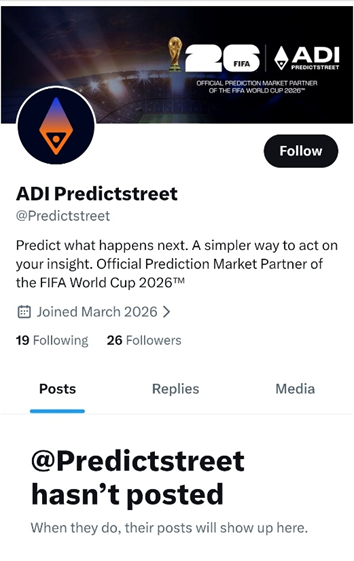
While Polymarket and Kalshi are both at least five years old, Fifa’s new prediction market partner, ADI Predictstreet, is an Abu Dhabi-based company which does not yet have a working product. At the time of the launch announcement, the company had two websites, one of which was offline. Both domain names were purchased at the end of January. Its X account, registered in March, had yet to post.
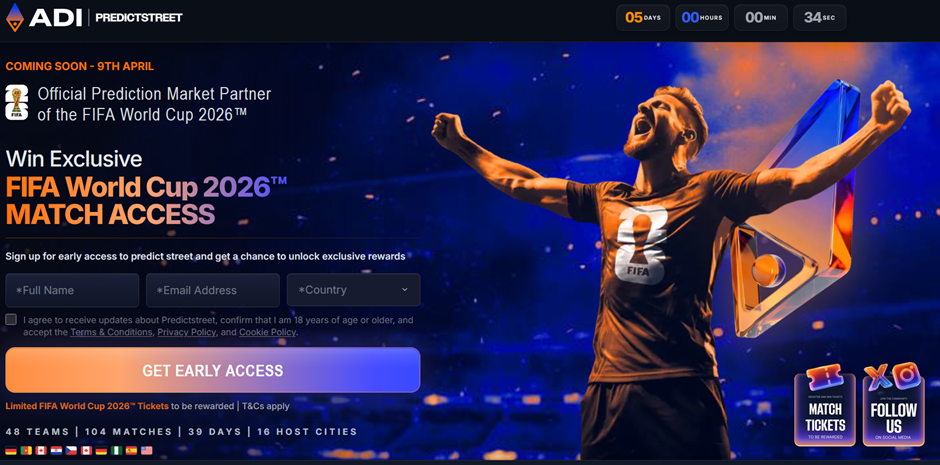
According to its website, Predictstreet’s service will go live on 9th April, just over 60 days before the World Cup kicks off. What the extent of its offering will be is unclear, though it’s unlikely to rival Polymarket or Kalshi, which offer hundreds, sometimes thousands, of markets at any one time and, according to the FT, processed more than $13bn of bets in November 2025. Nearly half a billion USD have been bet on the “2026 Fifa World Cup Winner” market on Polymarket alone as of 6 April 2026.
Barely legal
Beyond that, Predictstreet has no app available on Apple and Google stores yet, and received its gambling licence in Gibraltar as recently as 26th March – only a week before it was announced as a Fifa partner. That licence does not permit Predictstreet to operate outside Gibraltar. The platform is unlicensed in most parts of the world, including large swathes of Asia where betting is against the law. It is illegal according to the definitions of the Macolin Convention and the World Lottery Association (WLA). It doesn’t even hold a licence in the country its owners operate from, the United Arab Emirates, one of a handful of Arab or Muslim countries to have set up their own gaming authority.
This means that, at least for now, only Gibraltar’s 38,000 residents will be able to use the prediction market legally. All of which raises questions about how Fifa assessed Predictstreet’s quality, performance and reliability before agreeing to the deal.
PredictStreet, however, has solid backing. The company is owned by the ADI Foundation, a non-profit blockchain project owned by Sirius International Holding, itself a subsidiary of the International Holding Company (IHC). IHC is majority owned by the Royal Group, which invests directly on behalf of the Abu Dhabi royal family.
In other words, Fifa’s new prediction partner is owned by a powerful local government and an Emirate which owns, among other businesses, the City Football Group.
The company says that its prediction market will run on the blockchain. (Polymarket does this too, settling trades in USDC, a stablecoin pegged to the US dollar.) In late 2025, the ADI Foundation launched its own blockchain – ADI Chain – setting its test network live, along with the ADI token, its own cryptocurrency. The value of this token has almost quadrupled since, rising from 1.1 USD to 4.3 USD as of 4 April 2026.
Yet, there is little sign of real use. While Predictstreet is backed by an existing crypto infrastructure, no evidence can be found of any other businesses currently built on and using the ADI Chain. The ADI token, meanwhile, is barely traded, with a 24-hour volume in the low millions of dollars over the last few days, and a few hundreds of thousands of dollars a day before that. All of which raises the question of how long it would take to build a robust, scalable prediction market website and app from scratch using a still-experimental blockchain.
Park Lane
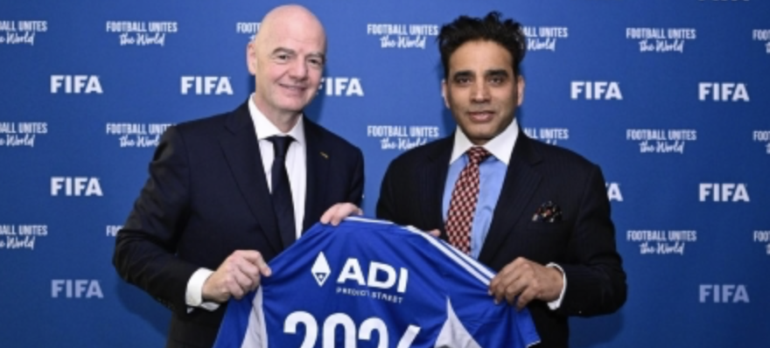
The key man for Predictstreet is Ajay Hans Raj Bhatia, the Principal Council Member of ADI Predictstreet who was photographed last week inking the deal with Fifa President Gianni Infantino.
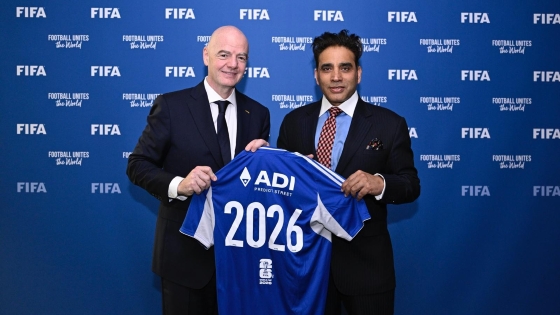
Bhatia, an Emirati citizen of Indian heritage, is a busy man. Last year, as Group CEO of Sirius International Holding, he represented IHC at Davos. In 2024, Bhatia was at Cop29 in Azerbaijan, on behalf of Smart Sustainability Solutions and Esyasoft, both companies in the IHC stable. He was also a part of the official Emirati delegation which welcomed Vietnamese PM Pham Minh Chinh when he visited the UAE in December 2023.
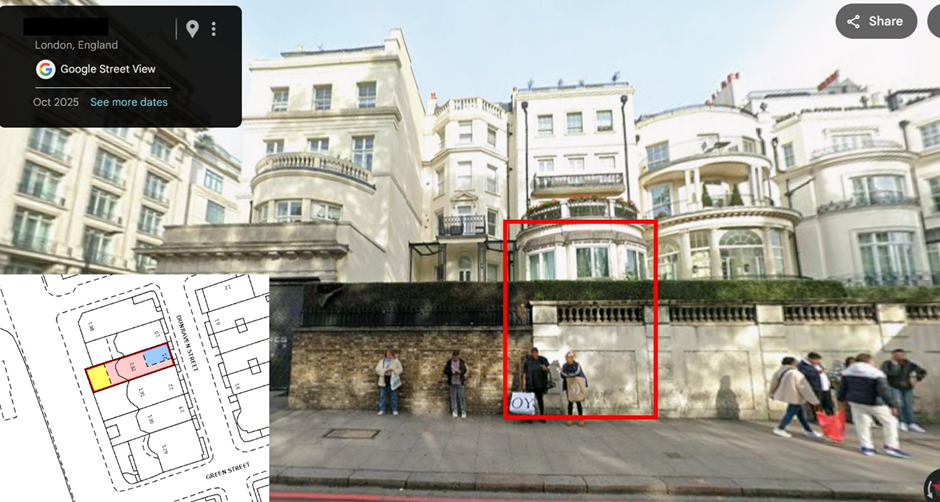
His wealth is also visible in London. He owns a flat on Park Lane, in the capital’s exclusive Mayfair area. The property, a three-bedroom, four-bathroom garden flat just across the road from Hyde Park, changed hands for £4,900,000 in March 2017. Bhatia bought it without a mortgage in late October 2024. The Land Registry records list its value only as “over £1,000,000”.
Insider trading
Bhatia’s record is not unblemished. In 2022, as CEO of QuantLase Lab – another IHC company – he was accused of insider trading by India’s Security & Exchange Board SEBI, linked to a $2bn USD investment in the Indian business conglomerate Adani. Bhatia had several days’ notice of the investment and was alleged to have made trades worth over £700,000 GBP in the shares of several Adani companies, making a profit of £45,000 GBP.
In mid-2024, a few months before the purchase of his Mayfair flat, Bhatia contacted SEBI and offered to settle, paying about £130,000 GBP, representing compensation and repayment of what SEBI called “unlawful gains.” He accepted a voluntary six-month trading ban in India. However, his offer came without “either admitting nor denying the findings of fact and conclusions of law.”
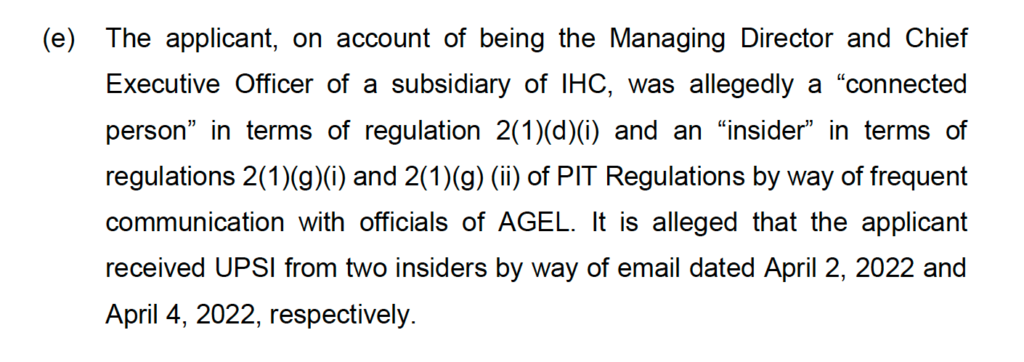
Following payment of the agreed amount, the settlement was formalised on 16th September 2025. The businessman was not, therefore, convicted of any criminal offence. His voluntary trading ban ended just two weeks before he signed Fifa’s prediction markets deal.
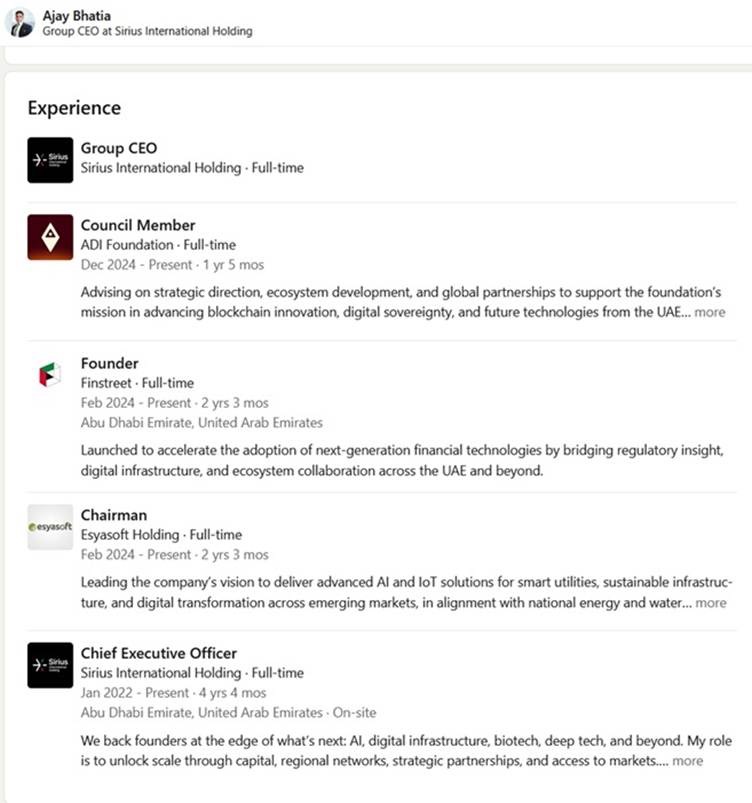
Bhatia’s career is something of a mystery. His Linkedin page, which is less than a year old, shows five current roles – all senior within the IHC empire. In his late 50s, Bhatia lists no previous employment or roles before 2022, with no mention of QuantLase Lab.
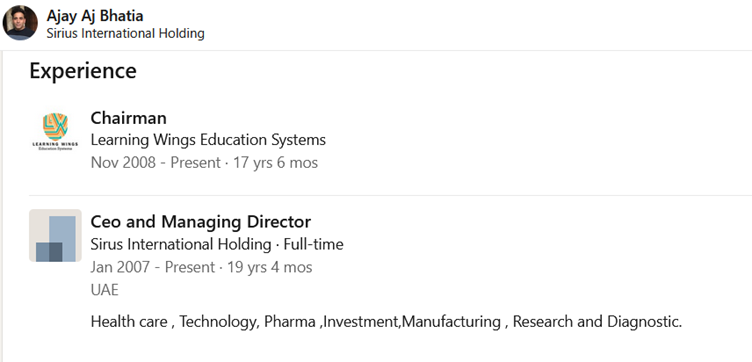
Bhatia has an old Linkedin page, created in 2017, which cites two roles: chairman of an education provider in India, and CEO of Sirus [sic] International Holding since 2007 – substantially predating his current claim of holding the position since 2022. The claim is even more puzzling because Sirius’ own Linkedin page says that the company was only founded in 2022, while the Internet Archive shows the company’s first functioning website as being cached in November 2023.
In light of the accusations of insider trading against Bhatia, Predictstreet’s questionable legal status around the world and the platform’s lack of active website, Josimar asked Fifa if it was confident that the company was a suitable partner for the World Cup.
Fifa did not respond to Josimar’s questions. Adi Predictstreet acknowledged receiving them.