
Despite a three-year failure to organise a national championship, the All Nepal Football Association (ANFA) retains the backing of the AFC and Fifa. They have issued a deadline on 4 May for the government to reinstate the suspended ANFA, following a string of administrative and legal breaches. Nepal’s players have become the first victims of the political standoff.
By Romain Molina and Sudesh Baniya
Dipesh Dhimal felt trapped. He had dedicated his life to football – he came up through the ranks, signed for Armed Police Force FC, one of Nepal’s most decorated departmental clubs, at the age of 21 and believed the game would take him somewhere – and yet in 2026, the defender, employed by local club APF, had little income. So, he took a drastic decision: he left Nepal behind and moved to Melbourne.
“This is not a choice, but a sad reality that we’re pushed into,” said Dhimal in an interview with Josimar from Australia where football is no longer his livelihood. His story mirrors that of at least a hundred Nepali professional footballers who have moved abroad to earn their living.
Football at home has come to a standstill. It’s been over a 1,000 days since Nepal’s topflight, the Martyrs’ Memorial A-Division League, established in 1954, has staged a match. No timeline has been confirmed for the resumption of the league. Between 1,250 and 2,100 players, across three tiers of Nepali football, will be deprived of regular football for yet another year, according to Bikram Lama, the president of the Nepal Football Player Association.
“It’s been almost three years now,” said Lama. “We have continuously tried to bring this issue to the attention of the federation through verbal and various measures. We started off with peaceful measures to remind them of the mess but they did not budge. Once it became clear that they are incapable of sustaining regular football operations, the leagues stopped and that is the biggest reason for where we stand today.”
Following the Gen Z protests that overthrew the government of the then-Prime Minister KP Sharma Oli, the players took their grievances to the gates of the federation’s headquarters twice. Last year, in November, they – having been denied entry at the door – draped their national medals over the federation’s iron gates in a public display of protest. In March, they returned and locked down the ANFA headquarters to demand a fixed date for the resumption of the topflight.
“Do not kill us players while we are still alive,” wrote national team defender Ananta Tamang, the last A Division League’s best player and former captain of defending champions Church Boys United. His contract at his current club, Fortis in Bangladesh, includes a release clause which allows for his return if the league is staged. “Today, the tag of being the defending champion feels like a burden to me. I want to play the league every year and become a champion, not just once and carry it forever.”
ANFA’s tainted history
The current crisis did not arrive without warning. For years, Nepal’s FA has been drifting, mired in scandal. In 2016, Fifa’s ethics committee banned then-ANFA president Ganesh Thapa for bribery. The Nepalese authorities also investigated Thapa for allegedly embezzling millions of development money. Thapa, however, has been vocal in his criticism of the current situation, a move sources interpret as a comeback attempt. Over the years, his son, Gaurav Thapa, has also held several positions at ANFA.
Fifa recently also lifted a four-year funding ban on ANFA.
Leagues were postponed, then cancelled, then replaced with watered-down alternatives, including the National League, devoid of promotion and relegation. In March, ANFA had to halt the National League, a single-round robin tournament with no relegation, because clubs fielded foreign players without appropriate visas and work permits.
The private franchise-based Nepal Super League and seasonal knockout tournaments have continued, but they don’t resemble a typical league structure. Rohit Chand, a national team player commented: “Regular footballing activities would have helped players sustain. The domestic leagues are the backbone of football in a country. Every stakeholder should feel accountable but they are focused on activities outside of what happens on the pitch.”

In Nepal’s football ecosystem, clubs in the three tiers – the A, B, and C Division League – hold the majority of votes in ANFA elections. It is a structural arrangement that, critics argue, has allowed federation leadership to prioritise electoral survival over institutional reform. “They have never had plans for football activities throughout the years and making the football clubs sustainable in themselves,” said Lama. “The main reason is that ANFA never works to improve the domestic structure. Their [ANFA leadership]’s only concern was how to stay on the throne for another four years.”
“And mainly, clubs are not inclined towards commercialisation but ANFA has never focused on R&D – on giving them a platform for sustainability. They have stayed quiet to please their voting members and nothing more. Nepali football is derailing due to personal interests.”
Although recent meetings were organised in conjunction with the Ministry of Sport to organise the A Division League within 120 days, nothing came of them. “When the dates neared, they (ANFA) backed off their promises and moved towards the National League and before that started, A Division dates should have been announced. But they did not,” explains Lama. “They started making excuses and then we locked the ANFA premises.”
Since 2016, ANFA has been entitled to more than $20 million in development funding from Fifa under the Forward programme, with over $16,246,685 of funds committed. In 2025, Fifa notes on its website, ANFA organised the B League with support of Forward Funding. Yet, the association has failed to run the top-tier league of the national championship for three consecutive seasons.
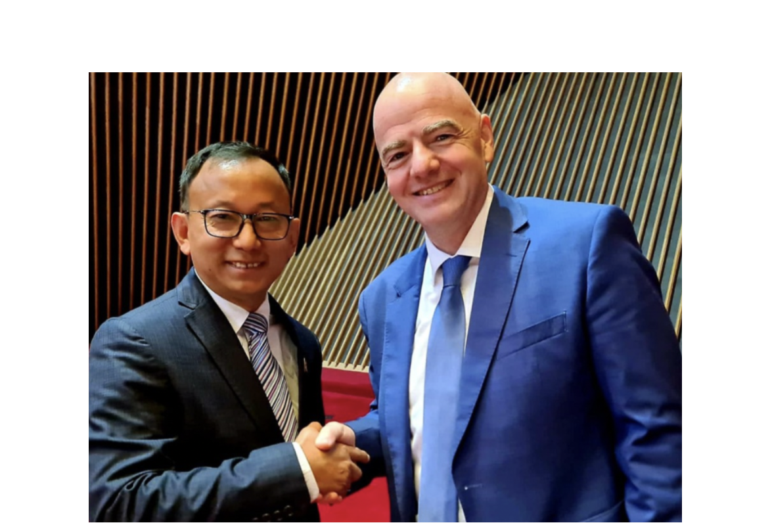
Instead, ANFA, curiously enough, was in far greater of a hurry to hold early elections. Elected in June 2022 for a four-year term and complimented on his success by Fifa president Gianni Infantino when the pair met on the eve of that’s year World Cup in Doha, president Pankaj Nembang had intended to stand for a second term on 11 February 2026, five months before the end of his first term.
Beyond the timing, the federation chose to bypass standard protocol, provoking the ire of several members of the executive committee and in certain districts. “The normal process would be to start from the district association elections and build on from there. But they tried holding the central elections without any prior requirements as they have a strong hold on district and provincial associations,” detailed Lama. “The early election is their propaganda to remain in power. But our National Sports Development Act says that a sports association’s election should happen from the bottom of the pyramid.”
Fifa against the National Sports Council
Following a complaint by a former employee, Amit Khatri, the Patan High Court issued a temporary order on 12 January suspending the electoral process. This was of no concern to the AFC and Fifa, who stated on several occasions in official correspondence that the electoral process should continue as planned, warning against any third-party interference.
Already angered by the state of Nepalese football, the National Sports Council (NSC), the state body overseeing national sport, subsequently prevented the elections from taking place on 11 February. The strained relationship with the federation soured further and, in particular, with its president, who was keen to secure his re-election. After multiple postponements and recriminations from both sides, the NSC suspended the ANFA for three months on 26 March for violating the National Sports Development Act, which governs sports associations.
Nepal’s government banned ANFA’s top 24 officials from travelling abroad, upon the NSC’s recommendation, and could soon launch an investigation into financial concerns according to several sources. Indraman Tuladhar defied the ban and travelled to India via land according to sources and local media before taking a flight to Canada to attend the recent Fifa Congress. Josimar sought comment from Tuladhar in Vancouver, but he declined.
Both the AFC and Fifa have urged the NSC to reconsider its position by 4 May, threatening immediate suspension of the footballing body over government interference.
In a letter dated 22 April, Fifa’s chief member associations officer Elkhan Mammadov and the AFC’s deputy secretary general Vahid Kardany wrote: “This decision – requesting ANFA to halt the ongoing electoral process, amend certain provisions of its Statutes, and require district associations to amend their statutes and hold elective general assemblies – significantly impacts ANFA’s autonomy and activities, and, as previously noted, constitutes in our view a clear case of undue third-party interference, in violation of ANFA’s obligations as a Fifa and AFC member association.”

Articles 14, 19 and 51 of the Fifa statutes prohibit political interference in the affairs of member associations (*) and outlaw member associations from referring Fifa’s actions to independent courts. The world federation often weaponises third-party interference to protect FA officials. In a report, NGO FairSquare wrote however that “it should not preclude governments from playing a role in ensuring effective regulation, or preclude law enforcement authorities, including the judiciary, from taking steps to prevent or punish corruption or other forms of criminality.”
The ban would exclude Nepal from participation in all Fifa and AFC competitions, risking a total collapse of the game.
Exile
The current paralysis has prompted an exodus of players. Back in Melbourne, Dipesh Dhimal plays football one or two days a week, part-time, for Nepbourne FC, one of a handful of Nepali diaspora teams now stacked with both capped and uncapped ex-Nepali professional footballers. It is, he said, enough to take the pressure off daily life and is a brief return to the only world he was built for. In a recent match, Dhimal got the opening goal against Himalayan FC.
“If the situation gets better, all of us here would be very happy,” said Dhimal. “Even if we don’t get to play back home, up-and-coming players there will have the opportunities we didn’t. There are many players who have dreams and are working towards donning the national team jersey. But they do not yet realise that they are stepping towards the unknown.”
Dhimal is one of more than an estimated 100 players who have departed Nepal. Lama explained: “Australia is just a small reflection of the large number of players who have left the country. There are numerous players who have ended their footballing dreams and left for the Middle East or Europe. There might be various reasons for that but players having to leave seeing no future in the sport is a pity. But the footballing leadership in the country doesn’t want to acknowledge the issue. They are only focused on the power they can gather. None of the players have left by choice. They have left because they were compelled to due to the dire situation.”
Last year, Dhimal was shortlisted to represent the national team in a double header against Bangladesh, but he didn’t quite make the final squad. Today, in exile, he is playing in the same league as several internationals, including Dinesh Rajbanshi, Tej Tamang and Suman Aryal, who regularly got called up.
Dhimal concluded: “No player aspiring to be a professional grows up with dreams of moving abroad to wake up early, coffee in hand and heading out just to get by. All we’ve known since we were kids is football. We have not been equipped with the skills to do much else. So, this is not a choice, it’s a sad reality we’re pushed into. Until Nepali football has good leadership, there will be plenty of players like us in line to take the same path we took.”
ANFA and Fifa did not reply to Josimar’s questions. Josimar tried to approach the ANFA delegation which attended the 76th Fifa Congress in Vancouver at the end of April, but in vain.
(*) “Member associations’ statutes must comply with the principles of good governance, and shall in particular contain, at a minimum, provisions relating to the following matters: (a) to be neutral in matters of politics and religion; (b) to prohibit all forms of discrimination; (c) to be independent and avoid any form of political interference;(d) to ensure that judicial bodies are independent (separation of powers)”